Reviewed and Verified by Anoop Prasad and Naga Lokesh, Digital Manufacturing & Practice
How SAP DM 2605 Improves shop-floor experiences, execution agility, and connectivity
Manufacturers are under increasing pressure to improve productivity, enhance operational visibility, and support a workforce that expects intuitive digital tools. At the same time, production environments continue to become more connected, data-driven, and dependent on real-time decision-making.
SAP Digital Manufacturing (SAP DM) 2605 addresses these challenges with a release focused on the people who execute manufacturing processes every day. With the General Availability of POD 2.0, expanded execution automation, and stronger connectivity capabilities, SAP continues its shift toward a more adaptive and worker-centric manufacturing environment.
Rather than delivering isolated feature enhancements, SAP DM 2605 introduces capabilities designed to simplify operator interactions, improve production data accuracy, and strengthen execution responsiveness across the shop floor.
The modern shop-floor worker takes center stage
The overarching theme of SAP DM 2605 is improving the day-to-day experience of operators, supervisors, and production teams.
As manufacturing organizations pursue Industry 4.0 initiatives, technology adoption increasingly depends on usability. Workers need systems that provide the right information at the right time without introducing unnecessary complexity.
SAP DM 2605 responds to this challenge by focusing on three key areas:
- Simplifying shop-floor experiences through POD 2.0
- Reducing manual effort through automation and smarter execution
- Strengthening real-time visibility through improved connectivity
Together, these enhancements help manufacturers create more responsive, efficient, and user-friendly production environments.
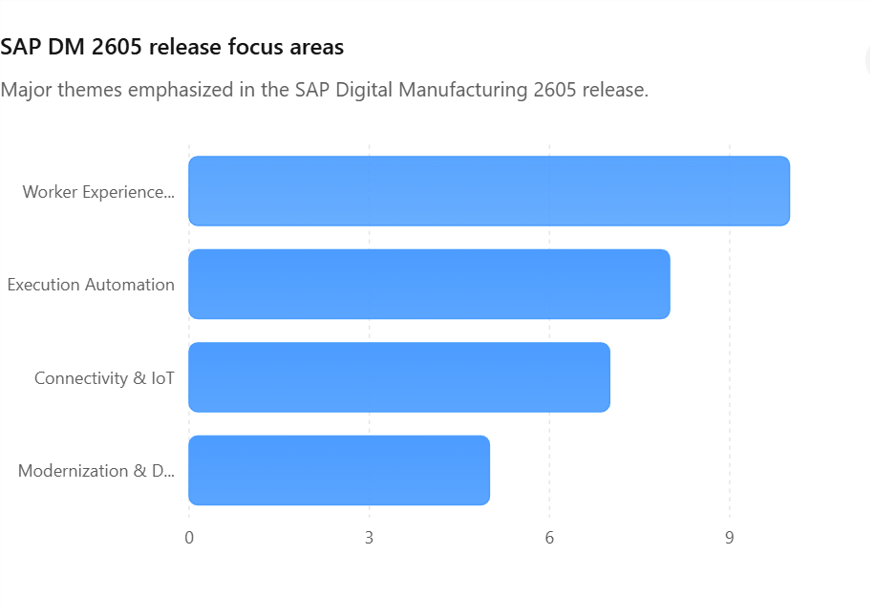
SAP DM 2605 is primarily a worker-experience release, supported by execution and connectivity improvements.
POD 2.0: The new standard for shop-floor experiences
The headline enhancement in SAP DM 2605 is the General Availability of Production Operator Dashboard (POD) 2.0.
More than a user interface refresh, POD 2.0 establishes a new framework for designing and managing shop-floor experiences. Previous POD environments often required significant configuration effort and customization. POD 2.0 introduces a more flexible and scalable approach that enables manufacturers to tailor operator experiences to specific operational requirements.
Key capabilities include:
- A visual WYSIWYG experience builder that enables drag-and-drop dashboard design
- Lightweight modular plugins that improve performance and scalability
- Direct integration with SAP Cloud Process Automation workflows
- Open extensibility for custom widgets, embedded content, and plant-specific functionality
From a business perspective, POD 2.0 helps accelerate deployment, improve user adoption, and reduce long-term maintenance effort. More importantly, it provides a foundation for future shop-floor orchestration by allowing manufacturers to align digital experiences with real production workflows.
Execution enhancements and smarter barcode automation
SAP DM 2605 also introduces several improvements designed to strengthen execution reliability and production data accuracy.
One notable enhancement is configurable barcode parsing. Manufacturers can now define rules that automatically interpret complex barcode structures, including GS1-style formats, and map information directly to production activities. This reduces manual data entry, minimizes errors, and improves execution consistency.
SAP has also enhanced scrap confirmation integration with SAP S/4HANA through the ERP_SCRAP_CONFIRMATION_V2 service. Additional execution metadata, including operation-level timestamps, improves traceability and supports more detailed operational reporting.
Inventory processing capabilities have also been expanded. Inventory V2 APIs now support larger payload volumes, improving performance for high-volume inventory transactions and goods issue scenarios.
These enhancements help manufacturers improve throughput, strengthen data quality, and reduce manual intervention across production processes.
Connectivity and IoT: More reliable machine-to-cloud communication
Reliable machine connectivity remains a critical requirement for modern manufacturing operations. SAP DM 2605 introduces several enhancements designed to improve communication stability and operational visibility.
Production Connector 3.1 is fully aligned with the 2605 release, supporting more consistent communication between shop-floor equipment and SAP Digital Manufacturing.
The release also introduces enhanced monitoring capabilities, including:
- “Last will” messaging that automatically alerts users when a connector unexpectedly disconnects
- Configurable keep-alive intervals that help identify communication issues faster
These updates provide manufacturing teams with earlier visibility into connectivity issues, helping reduce disruptions and improve confidence in real-time production data.
As Industrial IoT adoption continues to grow, reliable machine-to-cloud communication becomes increasingly important for maintaining operational continuity and execution accuracy.
Deprecations: What manufacturers need to prepare for
As part of SAP’s ongoing modernization strategy, SAP DM 2605 also introduces several deprecations that manufacturers should review.
The Data Engineering Framework associated with SAP ME replication has been deprecated. Applications including Manage Data Agents, Manage Connections, and Manage Data Replicas are expected to be removed in future releases.
In addition, legacy role templates associated with older visual inspection capabilities have been retired.
Organizations currently relying on these components should begin evaluating migration and transition strategies to ensure long-term platform readiness and avoid future operational disruption.
API Improvements
SAP continues to strengthen the Digital Manufacturing integration landscape with the introduction of enhanced API capabilities in the 2605 release.
New V3 APIs for resource & work center
The latest release introduces V3 versions of the Resource and Work Center APIs, enabling improved data retrieval and paving the way for more scalable, future-ready integrations.
Enhanced inventory APIs with higher record limits
A notable enhancement in the inventory domain is the ability to retrieve larger data volumes through the following endpoints:
• GET /api/v2/inventory/goodsReceipts
• GET /api/v2/inventory/goodsIssues
These APIs now support retrieval of significantly higher record counts (100–500 records per request), helping organizations improve reporting, analytics, and integration performance while reducing the need for multiple API calls.
This enhancement is particularly valuable for enterprises handling high transaction volumes and looking to optimize their SAP Digital Manufacturing integrations.
What SAP DM 2605 means for manufacturing leaders
The broader story behind SAP DM 2605 extends beyond individual features. The release reflects SAP’s continued investment in worker-centric manufacturing execution and connected operations.
POD 2.0 improves how operators interact with manufacturing systems. Barcode automation reduces manual effort and improves accuracy. Enhanced scrap processing strengthens traceability. Improved connectivity supports more reliable real-time operations.
Together, these capabilities help manufacturers move toward:
- Faster execution and decision-making
- Improved operator productivity
- Better production traceability
- Reduced manual intervention
- Greater operational visibility
- More scalable digital manufacturing environments
For organizations pursuing Industry 4.0 initiatives, SAP DM 2605 delivers practical enhancements that improve both workforce effectiveness and manufacturing performance.
Accelerating value from SAP Digital Manufacturing
SAP DM 2605 establishes a stronger foundation for worker-centric manufacturing execution by combining modern user experiences, smarter automation, and resilient connectivity into a unified digital manufacturing platform.
While the current release introduces important new capabilities, realizing their full value requires more than a technical upgrade. Manufacturers must align platform enhancements with operational goals, workforce requirements, and broader digital transformation strategies.
Körber Stellium helps manufacturers maximize the value of SAP Digital Manufacturing through consulting, implementation, integration, and optimization services tailored to modern manufacturing environments.
Schedule a Demo | Talk to our experts