Authored by Shreevatsan A, Innovation & Emerging Technologies, Körber Stellium
Why real end-to-end visibility only matters when it drives action, collaboration, and faster decisions
A modern supply chain control tower brings together data, visibility, exceptions, and decision support across the supply chain so teams can respond faster when conditions change. AI extends that role by helping identify patterns, prioritize disruptions based on business impact, add context, and recommend next steps. Combined with end to end visibility, this shifts the control tower from a passive monitoring layer toward a more actionable decision layer. SAP similarly describes modern control towers as using technologies such as AI and machine learning to provide end-to-end, real-time visibility and support faster response to disruption.
Key Takeaways:
- A supply chain control tower only creates value when visibility leads to action, not just awareness.
- AI helps by prioritizing exceptions, adding context, and recommending next steps, not just displaying data.
- Success depends on data foundations, clear ownership, and workflows as much as the technology itself.
Key Results:
- Exception resolution times cut by more than 40 percent in retail control tower case studies.
- Planning cycle times reduced by more than 35 percent after AI-enabled control tower adoption.
- Manufacturers report 15 to 25 percent improvements in on-time delivery after moving from passive dashboards to AI-supported orchestration.
From Visibility to Action: The Evolution of the Supply Chain Control Tower
For more than a decade, the supply chain control tower has been sold as the answer to visibility problems. Bring every shipment, order, and inventory position into one dashboard, and the business will finally see what is happening across its network. Many organizations built exactly that, and it helped. But a wall of screens showing shipment locations and exception counts only tells you what already went wrong. It does not tell you what to do about it, and it does not do it for you.
That gap is what AI is now closing. A modern supply chain control tower is no longer just a monitoring layer. It is becoming a decision layer, one that can prioritize exceptions, add context, and recommend a next step, so that end to end visibility actually leads somewhere. This article looks at how AI-enabled control towers are changing visibility, exception management, collaboration, and decision-making, what we have learned implementing them, and the measurable benefits organizations are seeing as a result.
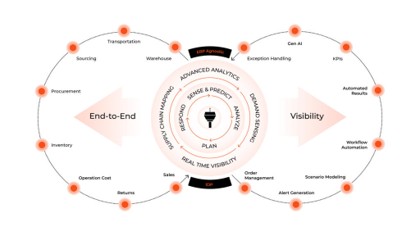
How is AI Changing the Supply Chain Control Tower
The contribution AI makes to a control tower tends to concentrate in four areas, and each changes the nature of the job differently.
End to end visibility
Traditional visibility tools stitch together data from ERP, warehouse, and transportation systems into a single view. AI adds a layer on top of that: pattern recognition across historical and live data that flags when something is drifting from normal, before it becomes a missed delivery or a stockout. Visibility stops being a static picture and starts becoming something closer to a live read of supply chain health.
Exception management
Most control towers surface far more exceptions than any team can act on. AI helps by scoring and prioritizing them, based on business impact rather than just the order they arrived in, and by grouping related exceptions, so a planner is not solving the same root cause five separate times. The team spends its time on what actually matters instead of triaging noise.
Cross Functional Collaboration
Visibility that stays inside one function does not travel far. AI-enabled control towers increasingly surface the same exception, with the same context, to procurement, logistics, and customer service at the same time, which shortens the back and forth that normally happens over email and phone calls when a shipment is at risk. Shared context, not just shared data, is what actually speeds up cross-functional response.
Ai-Supported Decision-making
This is the layer that matters most for the strategic point of this article. Rather than a dashboard full of numbers, a mature AI control tower recommends a next best action, such as rerouting a shipment, releasing safety stock, or flagging a supplier risk, while leaving the final call to a person who understands the broader business context a model will not have.
Visibility identifies the problem. decision support helps close it.
From Dashboards to Decisions: End to End Visibility in Action
It is worth being direct about the strategic point here. A control tower should change how fast and how well a supply chain responds, not simply give it more things to look at.
Visibility without ownership just produces a longer list of known problems. A planner who sees an exception but has no clear next step, no context on why it matters, and no defined owner will either escalate everything or ignore most of it. Neither outcome is good. The organizations getting real value from AI control towers treat visibility as the starting point of a workflow, not the end of one. That means:
- Every exception carries enough context, such as root cause, business impact, and recommended action, for someone to make a fast, confident call.
- Ownership is clear before an exception happens, not decided in the moment it appears.
- Success is measured by outcomes, such as exception resolution time, on-time delivery, and service level, rather than by how many data sources feed the dashboard.
This reframing also changes who need to be involved in a control tower rollout. It is not just an IT or data project. It is an operations and change management project with strong technical support behind it.
Supply Chain Control Tower Use Cases by Industry
AI control towers create value differently depending on the industry, because the nature of the exceptions and the pace of decisions differ.
Retail: Demand is volatile, seasonality is significant, and promotions create constant swings in what needs attention. Case studies across retail organizations that adopted AI control towers report exception resolution times reduced by more than 40 percent and planning cycle times reduced by more than 35 percent, largely because merchandising, transportation, and inventory teams are finally working from the same prioritized view instead of separate systems and separate assumptions.
Manufacturing and automotive: Here the priority is protecting production continuity against supplier and logistics disruptions. Manufacturers using AI-supported orchestration instead of passive dashboards report meaningful gains in on-time delivery performance, generally in the range of 15 to 25 percent, along with measurable reductions in the safety stock needed to buffer against uncertainty, because the control tower catches emerging supplier and transit risk earlier.
Third-party logistics and distribution: For a logistics provider working under strict service level agreements, the challenge is less about seeing problems and more about resourcing for volumes that are hard to predict. An AI control tower that improves near-term visibility into order volume lets these providers balance inventory and staffing more precisely, reducing waste and cost while still protecting service commitments, and creates room to build new services on top of the data they now have.
Pharmaceuticals and life sciences: Visibility here has to satisfy a higher bar. It is not enough to see a shipment is delayed. Teams need traceability that holds up to regulatory scrutiny and can show why a decision was made, not just what was decided. AI control towers built for this industry put as much weight on explainability and audit trail as on speed.
In each of these cases, the technology capabilities were similar. What differed was which exceptions mattered most, who needed to see them, and how fast a decision had to be made.
What to Consider Before Implementing a Supply Chain Tower
Control tower rollouts rarely stall because the AI itself is weak. They usually stall for more ordinary reasons.
Build the Right Data Foundation
Data quality sets the ceiling. A control tower is only as reliable as the systems feeding it. Disconnected ERP, warehouse, and transportation data, or inconsistent master data across regions, will limit what the AI can see long before the model becomes the constraint. This needs to be assessed and addressed early, not discovered mid-rollout.
Start with High-Value Exceptions
Start with a defined set of exceptions, not everything at once. Trying to monitor every possible disruption from day one produces noise, not focus. The control towers that gain traction start with the exceptions that cost the business the most, prove value there, then expand.
Define Ownership Before Go-Live
Ownership has to be assigned before Go live. An exception without an owner does not get resolved faster just because it was surfaced sooner. Defining who acts on which exception type, and giving them the authority to do so, matters as much as the technology.
Build Trust in AI Recommendations
Trust has to be earned, not assumed. Planners who have relied on their own judgment for years will not hand decisions to a system they do not understand. Showing the reasoning behind a recommendation does more for adoption than accuracy claims alone.
Plan for Change Management
Change management is not optional. A control tower changes how teams work day to day, including who looks at what, who escalates what, and who owns the follow-up. Organizations that invest in training and clearly redefine roles see the tool stick. Organizations that treat it as a system to log into tend to see it quietly ignored within months.
Business Benefits of an AI-Enabled Supply Chain Tower
Across the organizations we have supported and the wider case studies in the market, a consistent set of benefits shows up once an AI control tower moves from pilot to embedded practice:
- Faster exception resolution, often 30 to 40 percent faster than manual triage.
- Meaningful improvements in on-time delivery and service level performance.
- Reduced safety stock and expediting costs, since risks are caught earlier and with more context.
- Fewer hours spent manually consolidating data across systems, freeing planners to focus on judgment calls.
- Stronger cross-functional alignment, since procurement, logistics, and customer-facing teams work from the same prioritized view instead of separate reports.
Our Recommendations: Turning Visibility into Operational Impact
Based on what we have seen across real control tower implementations, here is what we would recommend to any organization starting this journey:
- Anchor the business case in outcomes, such as exception resolution time and service level, not in the number of data sources connected.
- Start narrow, on the exceptions and processes with the highest cost of inaction, and expand once value is proven.
- Give every exception a clear owner and a defined workflow before the system goes live.
- Invest in data integration and quality as seriously as the AI models themselves.
- Keep people in the loop on decisions with real consequences, and use AI to inform that judgment rather than replace it.
- Treat the rollout as a change in how teams work, with training and redefined roles, not just a new dashboard to open.
A supply chain control tower was always meant to help organizations see further and react faster. AI is what finally makes that promise practical at scale, not by replacing the people making decisions, but by giving them better information, sooner, with enough context to act on it. Visibility was never really the goal. Faster, better-informed action is, and that is the shift AI-enabled control towers are making possible.
Ready to turn supply chain visibility into faster, more informed action?
Talk to our experts about building a more connected, AI-enabled approach to planning and execution.