Authored by Toshif Husen Patil , Products & Innovation
From Supply Chain Visibility to Supply Chain Intelligence
There was a time when a digital twin meant a 3D model sitting in an engineer’s workstation, impressive to look at, rarely acted upon. That era is over.
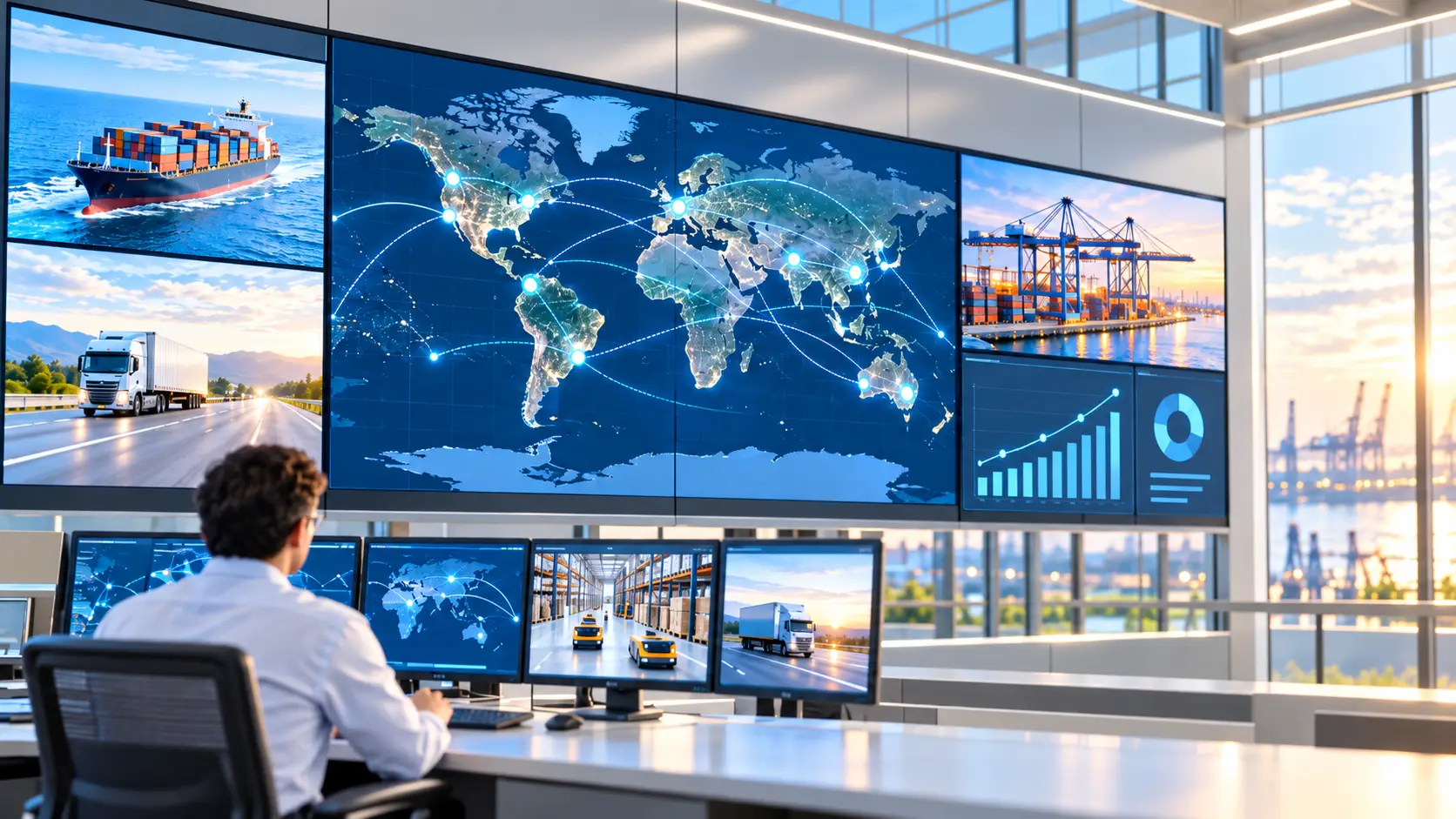
In 2026, digital twins have become the operational command centre of the modern supply chain. They don’t just reflect what is happening. They tell you what is about to happen, simulate what could happen, and help you decide what should happen before a single pallet moves, before a tariff reshapes a sourcing lane, before a bottleneck becomes a crisis.
This isn’t a trend. It’s a structural shift in how the world’s most complex supply chains are managed.

From Visualization to Decision Infrastructure
The original pitch for digital twins was compelling but limited: see your supply chain in one place. Real-time visibility. A dashboard that replaced fragmented spreadsheets and disconnected ERP screens.
That is now table stakes.
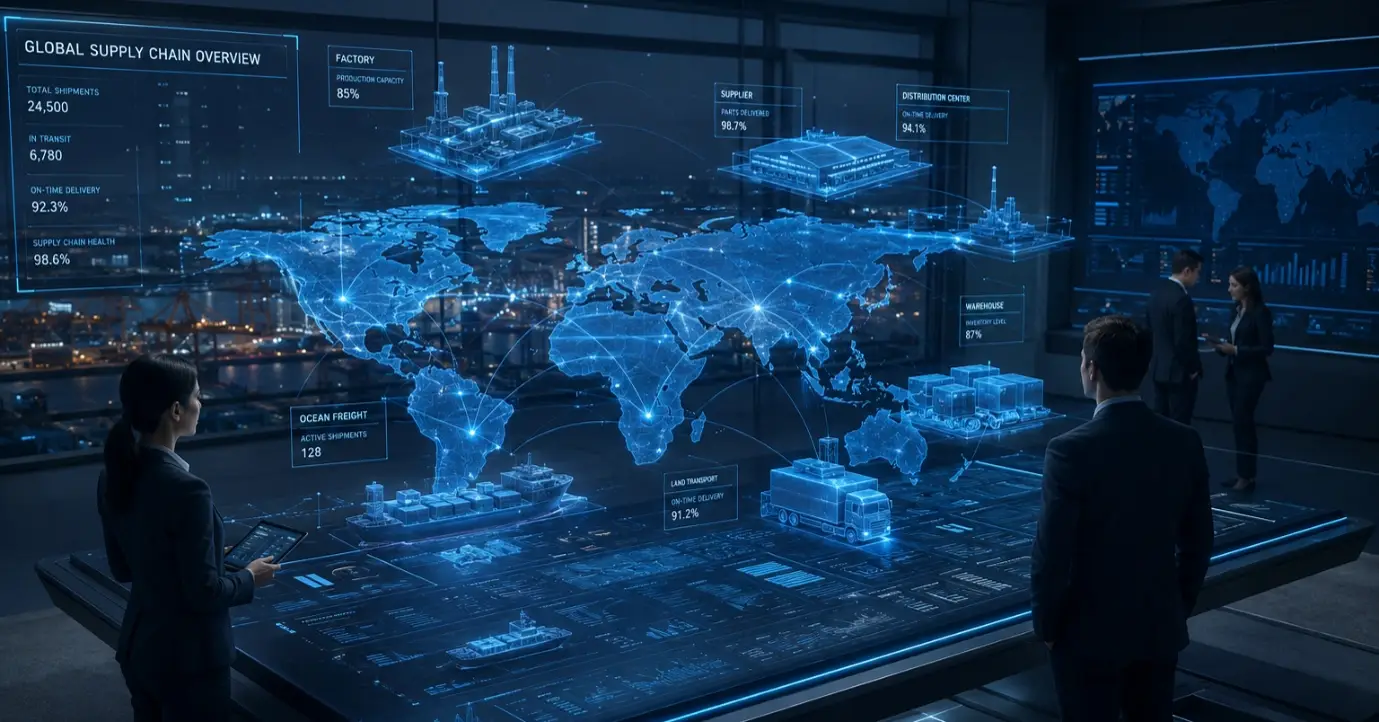
At Körber Stellium, we see today’s digital twins as far more than passive monitors , they serve as both a real-time control tower delivering actionable operational visibility and a powerful strategic simulation engine for scenario planning and what-if analysis.
That difference is game-changing.
A control tower might alert you that a port is congested.
A digital twin goes much further: it shows you which sourcing alternative delivers the lowest cost, the fastest transit, and the smallest carbon footprint — and lets you test and validate that decision in minutes, not months.
The real ROI of a digital twin lies in its ability to run what-if scenarios: what if consumer demand in a certain region increases by 40% next quarter? The simulation calculates exactly how that will affect operations and financials before any physical change occurs.
This is the leap from supply chain visibility to supply chain intelligence.
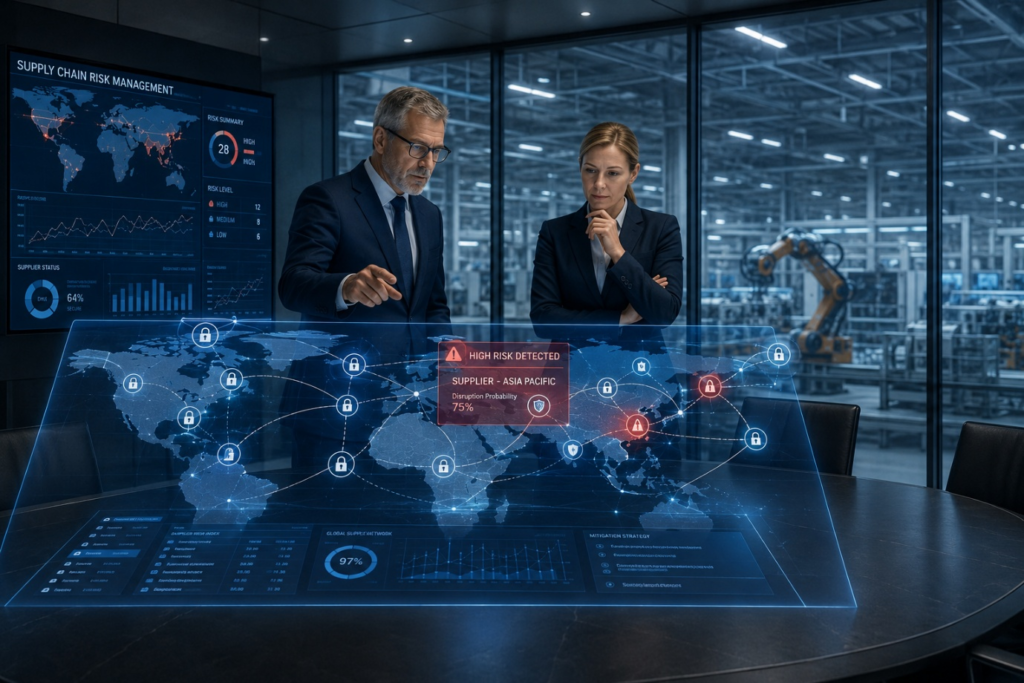
How Tariff Volatility Is Accelerating Digital Twin Adoption
The global tariff environment of the past two years has been, to put it plainly, relentless. New duties, retaliatory measures, shifting trade agreements, and unpredictable exemptions have forced procurement and logistics teams into near-constant replanning cycles. Organizations that relied on annual network reviews discovered that annual was no longer fast enough.
Tariff-related uncertainty is increasing the need for frequent scenario planning, making digital twin simulations more valuable for procurement and logistics decision-making. Companies that had invested in digital twin infrastructure before the tariff volatility hit found themselves with a meaningful structural advantage: the ability to stress-test sourcing decisions against dozens of trade scenarios simultaneously, rather than waiting for consultants to run the analysis offline.
An example of scenario planning in practice is stress-testing a supply network by simulating cost changes, capacity changes, or removal of nodes entirely for instance, network intelligence can reveal that the fastest route is highly unreliable and costly due to customs delays, making rerouting the preferable outcome.
For procurement leaders, this has been transformative. The question is no longer “what is our current cost-to-serve?” It is “what is our cost-to-serve under each of these five tariff scenarios, and which sourcing configuration is most resilient across all of them?”
Digital twin success stories in modern supply chains
The Real-World Case for Digital Twins: Three Leaders Setting the Benchmark
Siemens and PepsiCo: Compressing decisions from months to weeks
Announced at CES 2026, an industry-first collaboration between PepsiCo, Siemens, and NVIDIA set a new benchmark for industrial AI adoption. Siemens Digital Twin Composer, built on NVIDIA Omniverse, enables high-fidelity, real-time supply chain simulation and optimization compressing facility design and optimization from months to days.
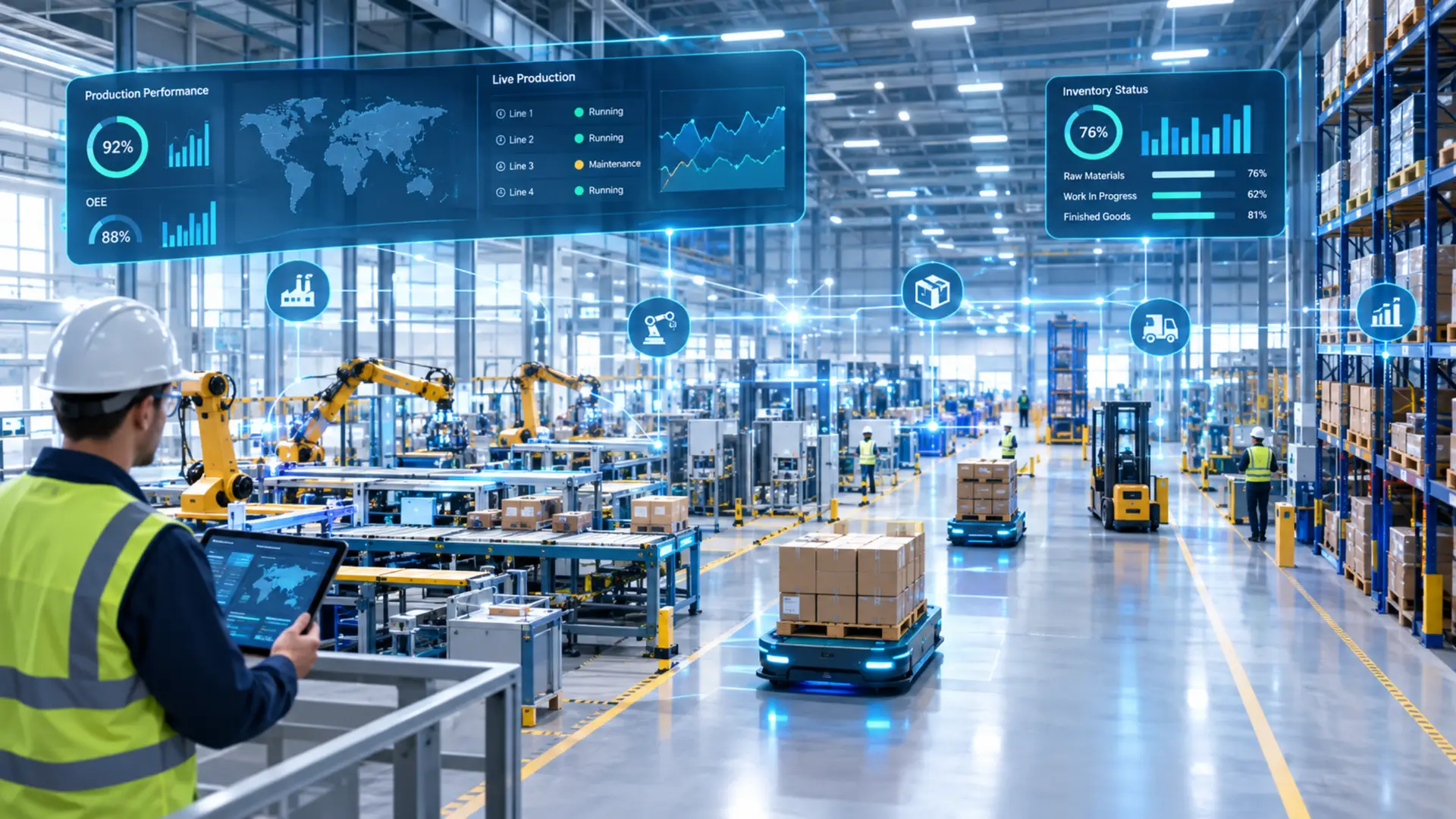
Using this technology, PepsiCo is reconstructing warehouse layouts, conveyor systems, operator movements, and pallet flows in a virtual environment. Supply chain planners can identify bottlenecks, test new distribution strategies, and validate equipment placement without modifying any physical infrastructure. Multiple scenarios can be evaluated simultaneously, accelerating decision-making processes that would traditionally take weeks or months.
For a company operating a farm-to-shelf supply chain at global scale, serving billions of consumers across thousands of touchpoints, this speed of decision-making is not a convenience. It is a competitive weapon.
Siemens has extended this philosophy across the full supply chain through a comprehensive digital twin that connects the product design phase, plant layouts and production simulation, and multi-echelon supply chain networks, enabling teams to make smarter decisions at every stage of the design-source-make-deliver continuum using one consistent data foundation.
Toyota: Extending forecast and supplier visibility
Toyota’s approach to digital transformation illustrates a different but equally powerful dimension of what these tools can do: extending visibility deep into the supplier network.
Toyota’s implementation of digital supply chain tools has transformed historically reactive processes into proactive planning systems, including an extension of forecasting from 13-week to 52-week horizons through cloud-based collaboration across its extensive supplier network. With a full year of forward visibility, supplier partners can optimize their own operations, reducing expedited shipping costs, overtime production, and emergency material sourcing.
Toyota’s digital twins, including those used at Toyota Europe via NavVis 360 mapping, simulate production flows, pre-empt bottlenecks, and optimize layouts — and have even contributed to reducing the company’s carbon footprint by minimizing unnecessary travel for planning purpose.
This is a significant point that often gets overlooked: digital twin-enabled supply chain planning isn’t just a resilience story. It is increasingly a sustainability story as well. When you simulate before you ship, you reduce waste, both financial and environmental.
Schneider Electric: Turning Supply Chain Excellence into Competitive Advantage
Schneider Electric ranked number one on the Gartner Top 25 Supply Chain list in: 2025, after ten consecutive years on the list. That consistency is not accidental. It reflects a deliberate strategy to treat supply chain excellence as a source of competitive advantage, not simply a cost centre to be managed.
Schneider Electric provides integrated end-to-end lifecycle AI-enabled Industrial IoT solutions with connected products, automation, software, and services, delivering digital twins to enable profitable growth for customers across more than 100 countries. Their own factories have earned multiple World Economic Forum Advanced Lighthouse designations, recognizing manufacturing sites that have scaled Industry 4.0 technology from pilot to full integration.
Schneider Electric’s Environmental Data Program now covers 110,000 commercial references, with a target of expanding to 155,000 by end of 2025, disclosing 14 environmental data attributes per product, including carbon footprint, energy efficiency, and recycled content. This level of product-level environmental transparency is increasingly being demanded by enterprise buyers and regulators alike, and digital twin infrastructure is what makes it operationally possible at scale.

BSH Home Appliances: Simulating Logistics Networks Before Making Physical Changes
One of the clearest case studies in practical digital twin deployment comes from BSH, the appliances group behind Bosch and Siemens household brands.
BSH operates 188 warehouses worldwide, including both in-house and outsourced facilities. Using the Siemens Supply Chain Suite, BSH created a digital twin of its finished goods logistics network, allowing the company to simulate different network configurations, warehouse locations, sizes, and service levels and evaluate scenarios based on cost, operational performance, and customer impact before any changes are implemented. Mendix
This is the archetype of how mature digital twin programs operate: not as a reactive diagnostic tool, but as a forward-looking planning engine that replaces gut instinct and expensive physical trials with rigorous virtual simulation.
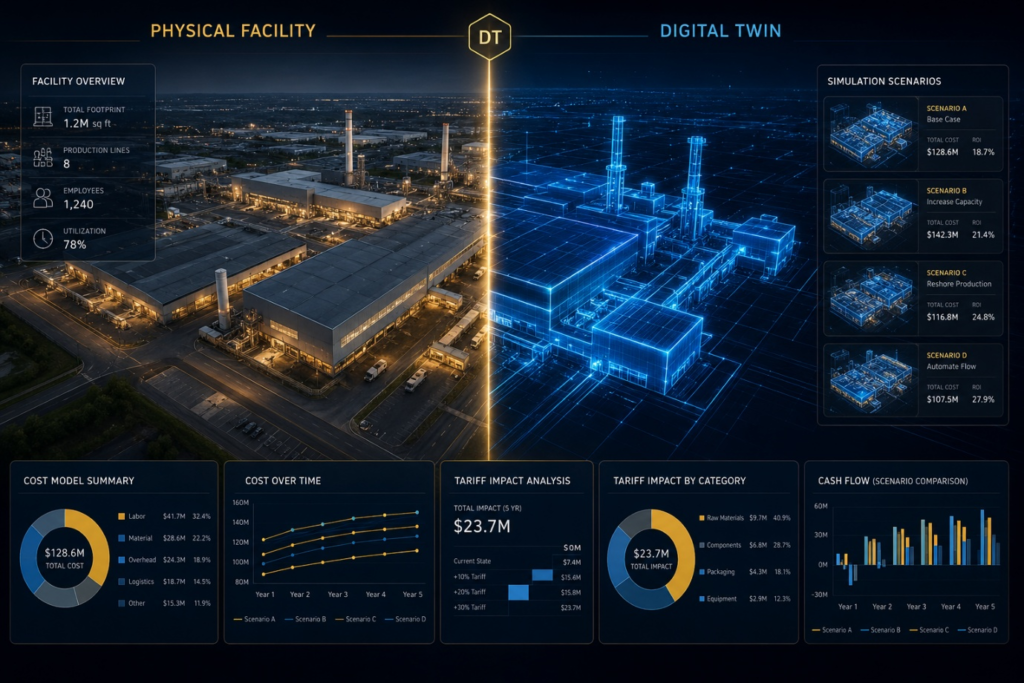
The Architecture Behind a Modern Supply Chain Digital Twin
Understanding why digital twins are outperforming traditional supply chain management requires understanding what they actually integrate. A mature supply chain digital twin is not a single application. It is a data fabric.
Digital twins use data from Enterprise Resource Planning systems, telematics systems, and warehouse sensor systems to ensure the virtual model behaves exactly as the physical supply chain does, integrating disparate data silos into a singular, cohesive dashboard that captures raw material locations, manufacturing throughput, and outbound logistics capacity. When a disruption occurs, a port closure, a sudden fuel price increase, this information updates in real time, enabling bottleneck prevention before the supply chain halts.
McKinsey research on advanced supply chain analytics deployments found cost-to-serve improvements in the 5–10% range and inventory reductions in the 15–30% range in mature implementations. These are not marginal gains. For a manufacturer running billions in cost-of-goods, a 20% inventory reduction is transformative working capital.
The Risk Layer Leaders Are Still Underestimating: IP, Data, and Legal Exposure
Digital twins create significant competitive advantages. They also create significant new risks, and most organizations are managing those risks reactively rather than proactively.
As adoption accelerates, organizations must understand both the strategic advantages and the legal issues that digital twin technologies present. A near-real-time virtual replica of factories, tooling, logistics lanes, and supplier operations that predicts disruptions before they occur is also an extremely sensitive data asset, one that raises hard questions about ownership, access, and liability.
Three risk vectors deserve specific attention from manufacturing leaders and digital transformation teams:
Data ownership and contractual ambiguity.
When a digital twin ingests real-time data from a supplier’s factory floor, machine performance, capacity utilization, yield rates, who owns that data? What can the buyer do with it? What happens if the supplier relationship ends? Most current supplier contracts were written before digital twins existed and are silent on these questions. This is a governance gap that legal and procurement teams need to close before a dispute forces the issue.
Intellectual property exposure in multi-party deployments.
When digital twin models are shared across an ecosystem, with logistics partners, co-manufacturers, or 3PLs, proprietary process data, production formulas, and network design logic can inadvertently flow to parties with whom competitive tensions exist. Due to industry rivalry, companies often do not want to share commercially sensitive information through digital twin platforms, and commercial pressures dissuade smaller firms from sharing models, resulting in consolidated control among a small number of dominant players. The governance model for what is shared, with whom, and under what contractual protection, needs to be designed intentionally. arxiv
Cybersecurity and system integrity.
A digital twin that is connected to live operational data is also a potential attack surface. If a bad actor can manipulate inputs to the twin, feeding it false sensor data, corrupting its simulation models, the resulting decisions could be operationally catastrophic. Supply chain security programs that focus exclusively on physical infrastructure are missing the digital attack surface that digital twin adoption creates.

Five Principles That Separate Digital Twin Leaders from Followers
Organizations currently leading in digital twin deployment share a set of common practices that distinguish their outcomes from those still running proof-of-concept pilots.
They started narrow and integrated deeply. Rather than attempting to twin the entire supply chain at once, they chose a single high-value domain, finished goods logistics, inbound supplier lead times, or a specific manufacturing site. They built a model that was genuinely connected to live operational data. Breadth without depth produces dashboards. Depth with integration produces decisions.
They invested in the data foundation first. A digital twin is only as good as the data it ingests. Organizations that skipped ERP data quality work, sensor deployment, and supplier data connectivity found that their twins reflected a clean version of the supply chain they wished they had, not the messy reality they operated.
They used scenario planning to drive procurement decisions. The organizations generating the most value from digital twins have made scenario simulation a standard input to sourcing decisions. Before signing a new supplier contract or committing to a new logistics lane, they run the network model.
They treated the legal and IP framework as infrastructure. Not an afterthought, not a legal department problem, but a foundational requirement for any deployment that involves multi-party data sharing.
They connected supply chain outcomes to sustainability metrics. The most advanced programs are using digital twins not just to optimize cost and lead time, but to model carbon emissions, water consumption, and material waste, turning sustainability from a reporting exercise into an operational variable.
Extending Digital Twin Value Through Supply Chain Excellence
Digital twins are becoming a cornerstone of modern supply chain strategy, helping organizations move from reactive operations to proactive decision-making. As these capabilities mature, many businesses are advancing toward AI-driven supply chain excellence, combining intelligence, automation, and real-time insights to build more resilient, adaptive, and continuously improving supply chains.
Körber Stellium Innovation Services, enhanced by Körber’s strategic collaboration with NVIDIA, are extending the value of digital twins in supply chains by creating physics-accurate, photorealistic virtual replicas of warehouses, logistics facilities, and entire operations using NVIDIA Omniverse.
This partnership combines Körber’s deep logistics expertise and real-world data with NVIDIA’s advanced AI, simulation, and physical AI capabilities. It enables organizations to simulate scenarios, optimize layouts, train robotics, predict disruptions, and test changes in a risk-free virtual environment before real-world implementation. As a result, supply chain professionals can achieve greater resilience, efficiency, agility, and speed-to-value , reducing costs, improving decision-making, accelerating automation adoption, and building more adaptive, intelligent operations across industries like retail, pharma, and e-commerce.
Learn more about the Körber-NVIDIA collaboration: https://www.koerber.com/en/about-us/news-and-press/ai-nvidia-collaboration.
Explore how Körber Stellium Innovation Services help organizations identify, validate, and scale emerging technologies that drive measurable supply chain transformation.