
Authored by Toshif Husen Patil , Products & Innovation
Agentic AI has crossed the threshold from experimentation to operational deployment – and it’s rewriting how supply chains sense, decide, and act without waiting for human instruction.
From alert to action: What agentic AI actually does
Why 2026 represents a turning point for Agentic AI
How organizations are realizing value from Agentic AI
The Governance framework that enables trusted autonomy
Why Agentic AI pilots fail from purgatory
The human + machine model: Designing for graduated autonomy
The operational foundation for autonomous supply chains
Why autonomous supply chains are becoming a competitive advantage
How to begin your Agentic AI journey
From alert to action: What agentic AI actually does
Traditional AI hands you a forecast and stops. Agentic AI picks up where the dashboard ends.
These systems perceive real-time operational data, reason over what action is needed, execute decisions across connected systems – ERP, TMS, WMS, procurement platforms – and adapt based on outcomes, all without waiting for a human to read an alert and make a call.
The shift from visibility to execution
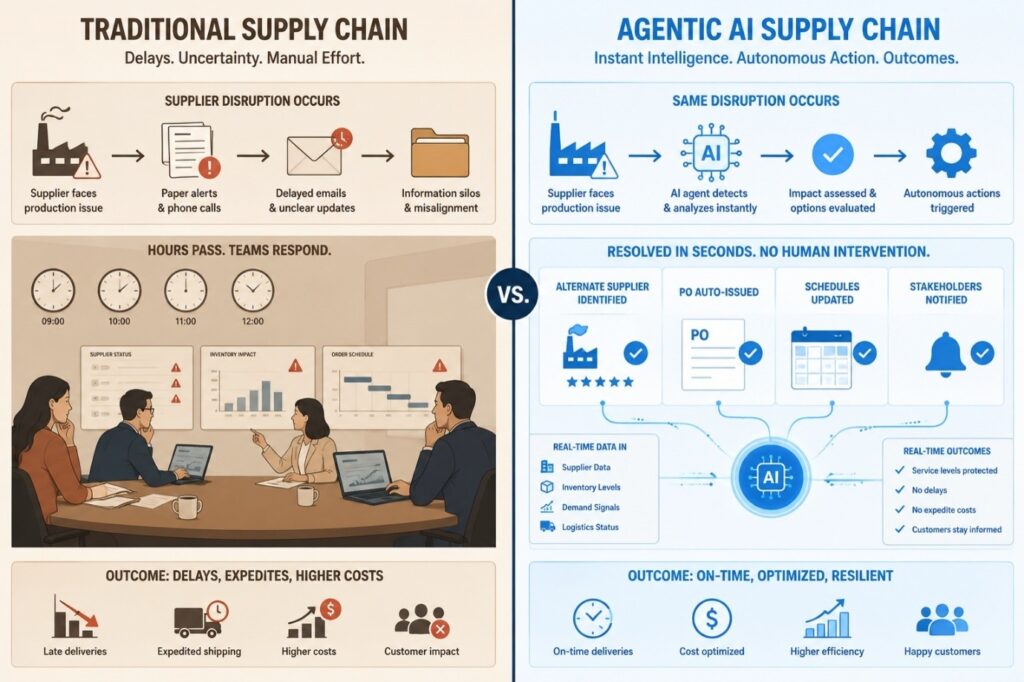
Consider a late inbound shipment. A conventional analytics platform flags it. An agentic system detects the deviation, evaluates backup suppliers against constraint rules, issues a purchase order to the preferred alternative, updates the production schedule downstream, and notifies the customer service team – all within minutes, all within a defined governance envelope.
Why decision latency matters
“Supply chains don’t break because of a lack of data. They break because the time between an anomaly appearing in the data and a corrective action being taken is measured in hours or days.”
That gap – between detection and execution – is where agentic AI concentrates its financial return. Every hour of decision latency in a high-volume exception scenario has a compounding cost. Organisations running production deployments are collapsing that window from days to seconds.
Why 2026 represents a turning point for Agentic AI
→ 50% of cross-functional SCM solutions will use intelligent agents by 2030 (Gartner)
→ 40% of enterprise apps will embed AI agents by the end of 2026 – up from less than 5% in 2025
→ 80% of manufacturing executives plan to invest in agentic AI this year
→ 78% of supply chain leaders expect disruptions to intensify – only 25% feel prepared
→ 34% average increase in supply chain efficiency among production deployers
→ +19% ROI over traditional automation in supply chain AI deployments (IDC)
The competitive divide is already emerging. The market is moving from $7.8 billion today to a projected $52 billion by 2030. This is not a future trend. It is a present-tense competitive divide.

How organizations are realizing value from Agentic AI
The highest-ROI use cases in 2026 share two structural characteristics: they target high-volume, repeatable workflows where the cost of exceptions compounds across the chain, and they integrate directly into the operational systems where decisions already happen.
The five domains with the clearest measured returns:
1. Logistics exception management
Agents monitor carrier performance, detect deviations in real time, re-route shipments, re-promise delivery dates to customers, and file supplier claims – autonomously, at scale. Port and terminal operations are an early proving ground, with agents managing yard scheduling, cargo tracking, and exception routing across complex multi-modal infrastructure.
2. Inventory replenishment and redistribution
Agents monitor stock levels across all nodes continuously, trigger replenishment before stockouts materialise, and redistribute inventory between locations based on real-time demand signals – replacing the weekly planning cycle with perpetual optimisation.
3. Procurement automation
Agents convert long-tail purchase orders into executed transactions, manage supplier qualification workflows, evaluate alternative vendors against cost-quality-lead-time matrices, and initiate contingency sourcing when primary suppliers miss performance thresholds – all within pre-defined spend authorities.
4. Predictive maintenance
IoT sensors feed real-time vibration, temperature, and power data to agents that detect degradation patterns, schedule maintenance proactively, order parts automatically, and update production capacity plans – preventing unplanned downtime before it cascades into fulfilment failures.
5. Demand forecasting and planning
Agents analyse sales signals, seasonality, external market data, and promotional calendars continuously – updating forecasts in real time and propagating changes upstream to suppliers and downstream to logistics partners. This evolution toward AI-driven demand planning enables organisations to move beyond static forecasting cycles and improve forecast accuracy through continuous learning.
What production-ready Agentic AI looks like in practice
General Mills : AI at scale
General Mills deployed an AI-driven supply chain optimisation system that autonomously assesses over 5,000 shipments daily – evaluating routing, timing, and vendor performance, and flagging only genuine exceptions for human review rather than pausing for approval on every decision. The result: $20M+ in supply chain savings since FY2024.
JPMorgan: Multi-agent architectures in production
At JPMorgan, 450+ agentic AI deployments are running in production across trade settlement, fraud detection, and automated document generation – demonstrating that at sufficient scale, multi-agent architectures are operationally viable across complex, high-stakes workflows.
What successful organizations have in common
The organisations achieving the strongest results are not necessarily using the most recognised AI brands. They are deploying platforms that go deepest into their specific operational workflows – with the integration coverage, governance depth, and audit capability that production environments require.
The Governance framework that enables trusted autonomy
The organisations deploying successfully are not simply turning agents loose. They are running a three-tier governance model – and the structure of that model determines whether autonomy scales or stalls.
Tier 1 – Fully autonomous execution
High-volume, routine, reversible decisions where the cost of exception is well-understood and the agent’s authority is clearly bounded. The agent acts, logs, and moves on. e.g. standard replenishment orders below spend threshold, carrier re-tendering within approved network
Tier 2 – Automated recommendation with approval
Medium-risk decisions where speed matters but a human in the loop can intervene within a time-boxed window. The agent acts unless overridden – not the reverse. e.g. emergency supplier switch above $50K, customs classification on novel product categories
Tier 3 – Human-led decisions with agent support
High-stakes, novel, or contractually binding decisions where human judgment is non-negotiable. The agent prepares the analysis, models the options, and flags the decision – a human executes. e.g. multi-year supplier contracts, major network redesign, cross-border regulatory commitments
The role of guardrail agents
The most sophisticated deployments add a fourth layer: guardrail agents – lightweight models that intercept primary agent outputs before they reach systems of record. If a procurement agent initiates a transaction exceeding its behavioural baseline, the guardrail agent triggers a confidence check and, if the threshold is not met, physically blocks the action and routes it to human review. The audit trail is immutable. Every action is logged.
Microsoft articulated the ambition in May 2026: agentic AI moves “from intelligence to impact by linking data, decisions, and execution across the supply chain.” The governance layer is precisely what makes that link trustworthy enough to act on at enterprise scale.

Why Agentic AI pilots fail from purgatory
The gap between the 80% of executives planning investment and the far smaller share running production systems is real, and it has a specific cause. Most pilots fail not because the AI technology is insufficient, but because the organisational infrastructure beneath it is not ready.
1. Data quality gaps
Agentic systems require clean, real-time data from ERP, WMS, TMS, and procurement systems simultaneously. Siloed, stale, or inconsistent data produces confident wrong decisions at machine speed.
2. Shallow integration architectures
A platform that can read data and surface recommendations is a copilot, not an agent. True agentic execution requires write access to ERP records, the ability to trigger approvals, and direct integration with operational systems.
3. Undefined authority envelope
Autonomy without a clearly delineated permission boundary is ungoverned automation. Pilots stall when business owners cannot articulate what the agent is and is not allowed to decide.
4. Planner trust deficits
A planner who does not trust agent recommendations will override them on instinct. Nuisance alerts destroy adoption. The path to value runs through earned trust, not mandated usage.
5. Measuring AI instead of business outcomes
Performance, not operational impact, ROI should be measured in operational performance indicators: exception resolution rate, decision cycle time, inventory carrying cost, on-time delivery improvement. Not model accuracy scores.

The human + machine model: Designing for graduated autonomy
The most durable framing for agentic AI deployment is not replacement, but rather graduated autonomy
Designing for graduated autonomy
A model where human judgment and machine execution operate in defined domains, with the boundary shifting over time as trust accumulates and performance data justifies expansion.
Building AI centers of excellence
Leading organisations are building Centres of Excellence: hybrid teams combining domain expertise with AI engineering capability, responsible for defining the authority envelope, monitoring agent performance, and managing the ongoing expansion of autonomous scope as the evidence base grows.
Many of these initiatives form part of broader AI-driven supply chain transformation programs focused on scaling intelligence, automation, and resilience across planning and execution processes
The narrative around human-in-the-loop is also maturing. Rather than treating human oversight as an acknowledgement of AI limitations, sophisticated deployments treat it as an architectural feature – a dynamic, policy-driven capability that assigns the right level of oversight to each decision type, enforced through identity controls at the agent level.
The operational foundation for autonomous supply chains
Before agents can act, foundational capabilities must exist
✓ Unified data layer – a single source of truth connecting ERP, PLM, and market intelligence. Agents act on the data they receive, and data quality is not recoverable downstream. Modern organisations are increasingly investing in AI-powered supply chain intelligence capabilities to connect operational data, business context, and decision-making across the enterprise
✓ Real-time integration coverage – direct write access to the operational systems where decisions execute, not just the analytics layer where decisions are visible.
✓ Ontology and constraint model – a structured representation of your supply chain’s rules, relationships, and boundaries. The knowledge layer that tells agents what they can and cannot do.
✓ Governance and audit infrastructure – immutable logs, escalation paths, confidence thresholds, and guardrail agents embedded in the architecture, not bolted on after deployment.
✓ Change management and trust-building programme – the human adoption curve is as important as the technical integration. Planners who trust the system will extend its scope; those who don’t will circumvent it.
Why autonomous supply chains are becoming a competitive advantage
The question for supply chain leaders in 2026 is no longer whether to deploy agentic AI. The organisations that have figured this out and those still running pilot dashboards are diverging rapidly – in cost structure, resilience, and response speed.
Responding faster to disruption, turning uncertainty to advantage
The urgency is compounded by the operating environment. Geopolitical fragmentation and tariff volatility are running at a 97% threat level according to Everstream Analytics. In this context, the ability to sense a disruption, evaluate options, and execute a response in seconds – rather than convening a meeting to decide one – is not a technical feature. It is a competitive capability that either exists in your operation or exists in your competitor’s.
“Success in 2026 means using uncertainty as a competitive weapon – simulating scenarios via digital twins, activating agentic AI to secure alternative capacity, and leveraging verified data without delay.”

How to begin your Agentic AI journey
Start with a high-value, contained use case
Select one high-value, contained use case. Logistics exception management and standard replenishment are the recommended starting points – ROI is measurable and the risk of autonomous execution is lowest for routine, repeatable decisions.
Build governance alongside technology
Establish your data foundation before selecting your deployment platform. Build the governance architecture in parallel, not after. Measure operational outcomes, not model metrics.
Scale based on evidence
Expand the authority envelope only as the evidence base justifies it. The organisations realising double-digit efficiency gains and compressing decision latency from days to seconds did not get there by running larger pilots. They got there by making the organisational commitment to run production systems – with the data, governance, and change management discipline that production requires.
The threshold has been crossed. The question now is which side of it your operation is on.
Agentic AI in Supply Chains: Turning Potential into Measurable Results
Agentic AI is moving from experimentation to real-world supply chain operations. The organizations seeing the greatest impact are those that can identify the right use cases, build a clear roadmap, and scale adoption with confidence.
Ready to Move Beyond the Pilot Stage?
Explore our Innovation Services and discover how Körber Stellium helps organizations turn emerging technologies into measurable supply chain outcomes.