Authored by Vijayesh M T, SAP Digital Manufacturing & Practice, Körber StelliumWhat do supply chain and IT leaders gain when SAP Digital Manufacturing replaces manual reporting with real-time production visibility, built-in OEE, and self-service dashboards that can go live from day one.
Most manufacturing organizations are running on information that is already hours old by the time they reach the people who need to act on it. A shift report compiled after the fact. A quality summary reviewed the next morning. An ERP transaction posted after the order is complete. The data is there, but it arrives too late to change anything.
Why Shop Floor Visibility Matters Across Every Level of the Organization
How SAP Manufacturing Analytics Architecture Works
Manufacturing Analytics in Practice at Al Hatab Bakery
Turning Execution Data into a Strategic Asset
SAP Digital Manufacturing changes the timing of that conversation. Its analytics layer surfaces production, quality, and asset information as execution happens, not after it is consolidated and reported. This article explains what that looks like in practice for supply chain and IT leaders, and what Körber Stellium built using using SAP DMi capabilities.
Why Shop Floor Visibility Matters Across Every Level of the Organization
The visibility gaps manufacturing leaders deal with tend to look the same regardless of industry or plant size. Supply chain and IT experience them differently, but they trace back to the same root cause: execution data that never makes it to a decision maker in time.
| What supply chain leaders experience | What IT leaders experience |
| Production summaries arrive hours after the shift ends | Reporting systems held together by custom code no one fully understands |
| Quality deviations found after the batch has already moved on | Maintenance overhead for on premises infrastructure tied to SAP MII |
| No clear view of which line is underperforming and why | Point to point integrations between shop floor and ERP that break quietly |
| Inventory mismatches between ERP and what is physically on the floor | SAP MII mainstream support ending December 2027, no upgrade path |
| Manual shift handovers create gaps in accountability | Every new analytics request from operations becomes an IT project |
These are not technology problems at their root. They are information timing problems. The data exists. What has been missing is a platform that collects it from execution, structures it for analysis, and makes it visible without a reporting project sitting between the event and the insight.
How SAP Manufacturing Analytics Architecture Works
SAP Digital Manufacturing has two connected capabilities working together. SAP DMe handles execution on the shop floor: orders, workflows, confirmations, and goods movements. SAP DMi takes the data produced by that execution and transforms it automatically into structured analytics objects called Manufacturing Data Objects (MDOs).
MDOs are created and maintained by the platform in the background, with no manual configuration or data model design required. The architecture below shows how the layers connect:
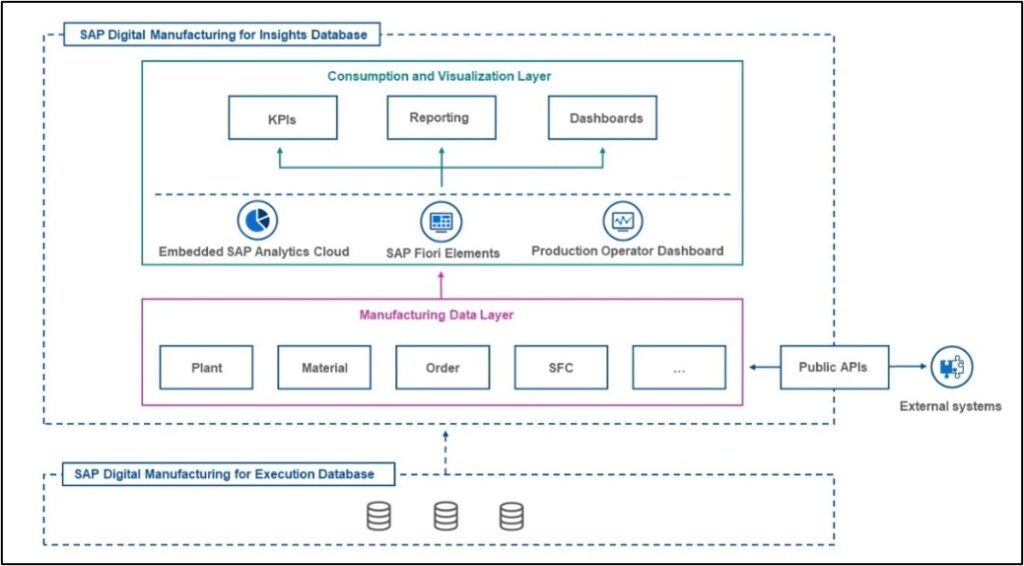
SAP Digital Manufacturing for Insights architecture. Source: SAP
The Manufacturing Data Layer at the center holds all structured production data, organized by plant, material, order, SFC, and more. Above it, Embedded SAP Analytics Cloud, SAP Fiori Elements, and the Production Operator Dashboard provide the consumption layer where KPIs, reports, and live dashboards are surfaced. External systems connect through public APIs when needed.
The critical point for both supply chain and IT leaders is that none of this requires a separate analytics platform to be procured, integrated, or maintained. It is built into SAP Digital Manufacturing from the start.
Core Capabilities Available from Day One
Line Monitor is the first thing most plant managers and supply chain leaders engage in SAP DM. It provides a live view of an entire production line across four perspectives:
| View | Business question it answers |
| Production | Are we going to hit today’s target, and which orders are slipping? |
| Quality | Is this batch going to meet spec, or is a problem developing right now? |
| Asset status | Which line just stopped, and how long has it been down? |
| OEE (Overall equipment effectiveness) | Where is efficiency being lost, and what is the root cause? |
Each view is live, color coded for instant status assessment, and drillable to the level of a specific machine, order, or batch. A supervisor does not need to open a separate quality system to see a scrap event or contact maintenance to find out whether a machine is running. It is all in the same screen, updated as events happen.
Alongside the Line Monitor, SAP DMi includes two built in operational reports available out of the box from day one: the Order Report, which gives a full view of order status, quantities, progress, and schedule across the plant, and the SFC Report, which provides the same depth at the level of individual shop floor control items or process batches. Both are filterable, sortable, and require no setup beyond the standard implementation.
Real-Time OEE Measurement Across Sites and Shifts
Overall Equipment Effectiveness is the metric almost every manufacturing organization tracks and almost none calculates consistently. When each plant defines planned downtime differently or includes changeover in performance loss while another site does not, the numbers across a multi-site operation cannot be meaningfully compared.
SAP Digital Manufacturing solves this with a standardized, built-in OEE engine. The calculation follows the industry standard formula across three components:
- Availability: proportion of planned production time the machine was running, based on downtime events logged during the shift
- Performance: actual output speed compared to the standard rate, with any shortfall flagged automatically as a speed loss
- Quality: ratio of good units to total units produced, linked directly to scrap and non-conformance events recorded at the point of manufacture
The scores appear in the Line Monitor in real time during the shift, color coded per work center. The same data feeds into the embedded SAP Analytics Cloud environment for historical trend analysis across shifts, lines, and plants.
For a supply chain leader, this means OEE stops being a number someone calculates and emails on Monday morning. It becomes a live signal that tells a supervisor during the shift whether to call maintenance, reallocate labor, or adjust the afternoon’s production sequence. For an IT leader, it means the calculation runs on SAP’s own logic, maintained by SAP, not on a custom query written years ago by a consultant who is long gone.
Self-Service Manufacturing Dashboards and Reporting Built into the Platform
The Manage Dashboards application in SAP DMi is where real flexibility shows. It uses the visualization capabilities of Embedded SAP Analytics Cloud, built directly into the platform, to let business users create their own reports and dashboards on top of MDO data through a drag and drop interface.
There is no coding required. No integration project. A supply chain analyst or quality lead connects the dashboard builder to the relevant MDO, selects the fields and visualization types they need, and publishes the report. It can be done in hours, not weeks. And when operational requirements change, the same person who built the report can update it without raising an IT ticket.
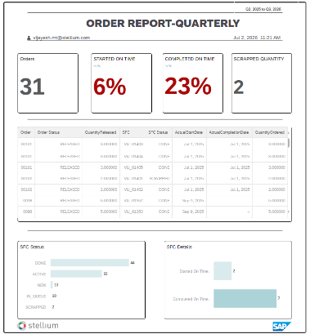
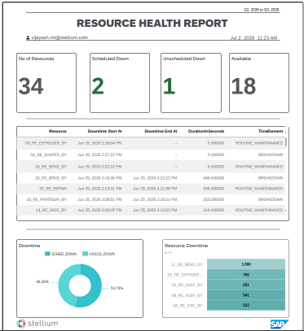
This changes the dynamic that has historically slowed analytics in manufacturing. In most plants, the gap between a business user identifying a reporting need and that report being available is weeks, sometimes months. In SAP DM, that queue largely disappears for standard operational reporting. IT sets up the platform and governs access. The business runs its own reporting from there.
Manufacturing Analytics in Practice at Al Hatab Bakery
Al Hatab Bakery is a food manufacturer where Körber Stellium implemented SAP Digital Manufacturing. Using the Manage Dashboards application within SAP DMi, the team built six operational reports during the implementation itself, designed around the specific decisions the business needs to make during and after each production run.
| Report | What it helps the business do |
| Production Scheduling | Track order progress against planned schedule across work centers in real time |
| Area Cooking Vessel Report | Monitor utilization and output per cooking vessel by production area |
| Batch Managed Report | Full visibility of batch status, consumption, and traceability through the production process |
| Cooking Vessel Report | Granular vessel level data for production teams managing capacity and throughput |
| Non-conformance Report | Live defect tracking linked to the specific order, batch, and step where it occurred |
| Area Cooking Vessel by Work Centre | Orders delivered by work center, giving supervisors a clear picture of output across the plant |
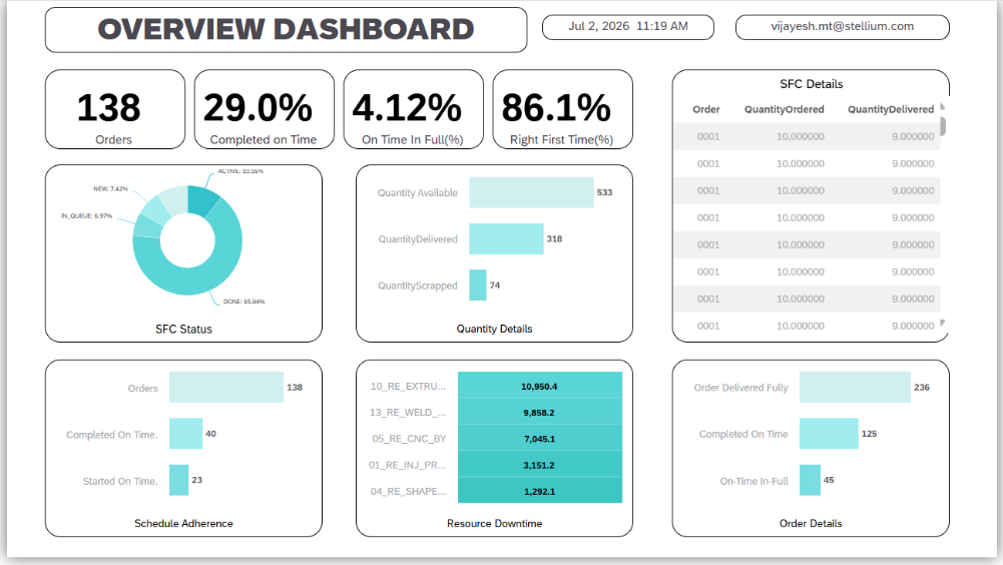
None of these reports required external tools or development work after go-live. The MDO data layer provided the source, the embedded SAC environment provided the visualization, and the business team had what they needed from day one. The structure of SAP DMi meant the reports were stable, maintainable, and extendable by the operations team as requirements evolved.
Read the SAP DM full implementaion story A More Scalable IT Architecture with SAP Digital Manufacturing Analytics
The analytics architecture of SAP Digital Manufacturing is worth calling out separately for IT leaders, because it changes the cost and risk profile of manufacturing analytics compared to SAP MII or any custom reporting layer.
- No custom data layer to maintain. MDOs are owned and maintained by SAP, updated quarterly with each platform release. IT inherits a stable, documented foundation rather than a schema of tables built during a project and rarely touched since
- Native S/4HANA integration. Process orders, master data, goods movements, and quality outcomes flow between S/4HANA and SAP DM through SAP’s standard integration. No middleware to manage separately
- Cloud architecture scales with production demand. SAP DM runs on SAP Business Technology Platform and removes the hardware ceiling that constrained on premises MII deployments
- SAP MII support ends in December 2027. Version 15.5 is the final MII release. Analytics built on top of MII from this point sits on a platform with no further investment
- MDO data is API exposed to enterprise tools. If the organization runs SAP Analytics Cloud Enterprise or SAP Datasphere, MDOs connect through standard OData APIs without a custom integration project
Turning Execution Data into a Strategic Asset
The most common reaction when plant managers first see SAP DM’s analytics live in a real plant is: we had this data all along. That is exactly right. SAP Digital Manufacturing does not generate more data. It structures the data already produced by execution into something that can be seen, compared, and acted on in real time, by the people responsible for production, not just the people who build reports.
If you are evaluating SAP DM for your organization, Körber Stellium’s SAP Digital Manufacturing practice brings experience in live plant environment implementations across industries. To see what implementation looks like, explore our SAP DM shop floor lessons article.
Talk to our experts to explore how SAP Digital Manufacturing can improve real-time visibility across your operations.