

Authored by Anoop Ramesh & Verified by Karthik Krishnan, Digital Supply Chain Practice, Körber StelliumImagine a customer places an order for a product that’s shown as “In Stock” in your system. Your warehouse team goes to pick it, only to discover the item isn’t there.
The result? Delayed shipments, unhappy customers, extra costs, and hours spent searching for inventory.
This is why inventory accuracy is one of the most important KPIs in warehouse management. It simply means that the inventory recorded in your system matches the inventory physically available in your warehouse.
Let’s explore why it matters, how SAP Extended Warehouse Management (EWM) helps, and the best practices to improve it.
How inventory accuracy impacts a warehouse
How does SAP EWM help improve inventory accuracy?
–Industry use cases and real results
Methods & Best Practices to Improve Inventory Accuracy
Sustaining inventory accuracy with SAP EWM
How inventory accuracy impacts a warehouse
When inventory is accurate, every warehouse operation becomes smoother—from receiving goods to shipping customer orders.
Business benefits of accurate warehouse inventory: Higher inventory accuracy contributes to:
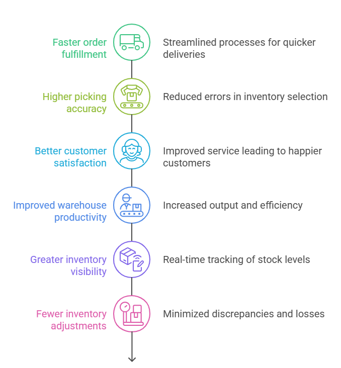
How does SAP EWM help improve inventory accuracy?
Inventory Accuracy is a key metric for any warehouse to operate efficiently. From order fulfillment to reducing nil picks, from OTIF to reducing lead times for the customer, Inventory accuracy plays a key role.
Most modern Warehouse management systems have functionalities and capabilities to maintain, check and correct discrepancies in inventory.
In SAP EWM, the key functionalities that help maintain inventory accuracy include:
| 1 RF scanning and task confirmation SAP EWM includes an embedded RF framework designed for handheld devices that can scan barcode information as input. This reduces manual typing errors and speeds up warehouse task execution when moving inventory. |
| 2 Unique storage bins and barcodes In SAP EWM, each physical warehouse location is defined as a unique storage bin with its own alphanumeric identifier. These bins can be barcoded and scanned through the RF framework, reducing the need for manual entry during warehouse transactions. |
| 3 RF error handling The SAP EWM RF framework helps prevent incorrect scans and inputs. For example, if an operator scans the wrong storage bin during putaway or picking, the system blocks the transaction and prompts correction, helping prevent inaccurate inventory postings. |
| 4 Physical inventory and cycle counting SAP EWM provides built-in physical inventory functionality to compare warehouse stock with system-recorded book inventory. Users can create count tasks for storage bins, perform blind counts, and allow the system to record differences as excess or shortage. Cycle counting can also be scheduled periodically, helping ensure the entire warehouse is counted within defined timeframes. |
| 5 EWM monitor reports SAP EWM includes standard reports that help identify and reduce inventory discrepancies. For example, the “ERP Stock Check” report compares EWM stock with ERP inventory. Additional physical inventory and stock reports help users monitor count progress, discrepancy postings, and potential mismatch areas such as stock on resources. |
In addition to the standard available EWM reports we at Koerber-Stellium have custom built KPIs in our proprietary product “AWA – Advanced Warehouse Analytics ”.
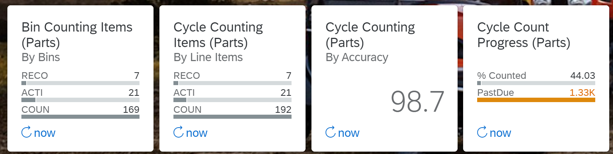
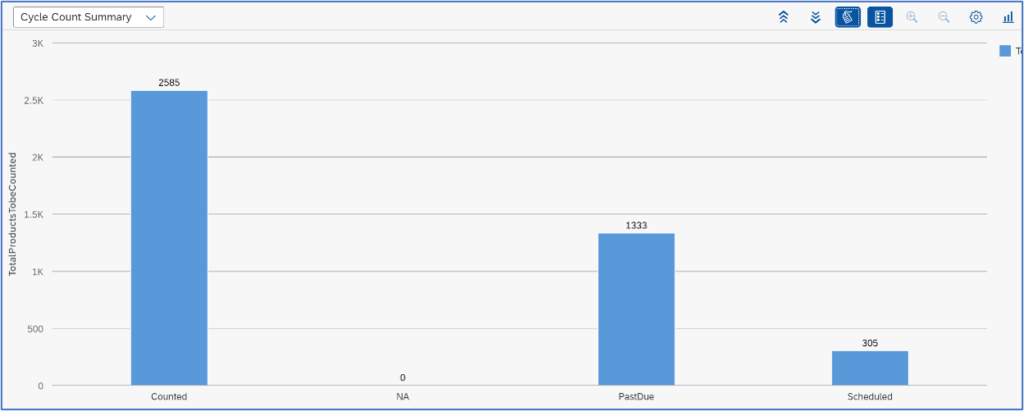
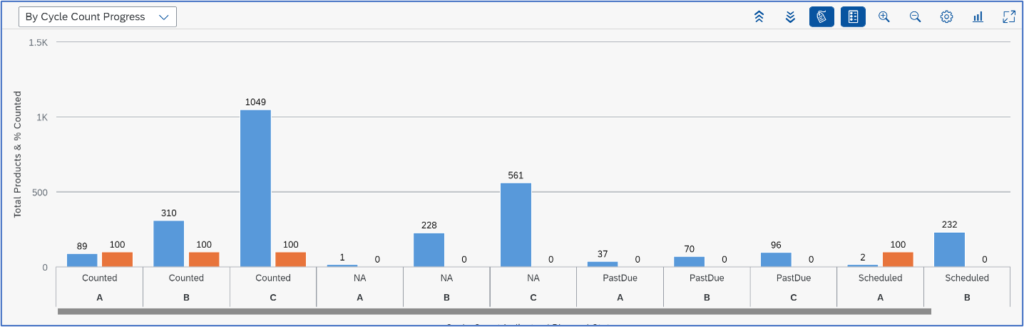
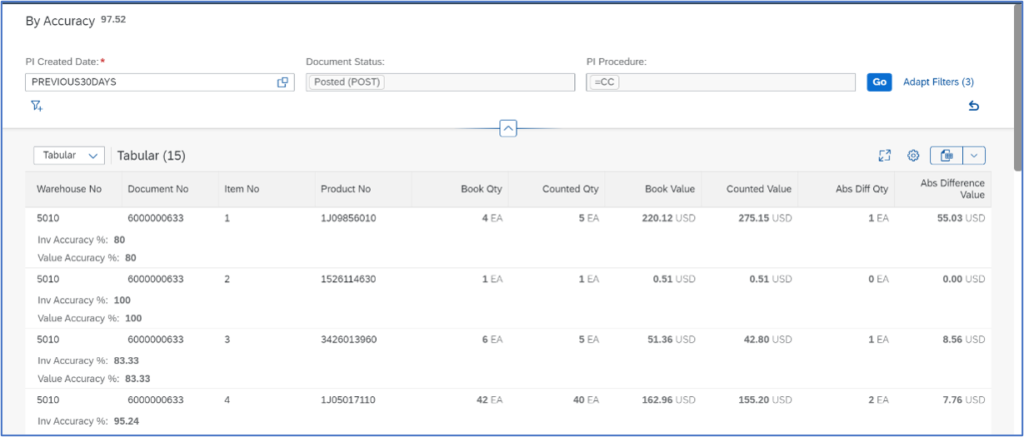
One of the KPIs measures inventory accuracy based on a number of factors like nill picks, physical inventory discrepancies, etc. Based on the information, KPIs show the inventory accuracy of the stock in the warehouse.
Industry use cases and real results
Automotive aftermarket: Faster rush-order fulfillment
An automotive aftermarket spares customer used the functionalities of EWM monitor reports to check, monitor and improve inventory accuracy in their Mother Distributive centre. This helped them reduce automotive time for rush and accident orders from 60+ hrs to within 24 hrs. This helped trucks and vcles broken down in the middle of the road to get the part needed for the fix.
Furniture manufacturing: More accurate distribution operations
A furniture manufacturing giant in US implemented EWM and helped track, maintain and improve inventory accuracy in their DC in Kansas City, KA to improve customer satisfaction in getting the right product delivered on time
CPG Retail: Reducing nil picks below 2%
An CPG retail customer in the UAE used extensive SAP EWM reports to maintain and keep a check on discrepancies in inventory so that inventory accuracy is maintained and nill picks are less than 2%

Methods & Best Practices to Improve Inventory Accuracy
Technology alone isn’t enough. Businesses also need standardized processes and disciplined warehouse operations.
Best operational practices
- Perform regular cycle counts instead of relying only on annual physical inventories.
- Use barcode scanners or RFID technology to eliminate manual data entry errors.
- Train warehouse employees on standard operating procedures.
- Organize warehouse locations with clear labeling and logical storage layouts.
- Investigate inventory discrepancies to identify and eliminate root causes.
- Monitor KPIs such as inventory accuracy, picking accuracy, and stock adjustments.
- Use automation wherever possible to reduce manual intervention.
Comparison: Common inventory problems and recommended solutions
| Common Challenge | Recommended Solution |
| Manual data entry errors | Barcode or RFID scanning |
| Picking mistakes | RF-guided picking with SAP EWM |
| Stock mismatches | Regular cycle counting |
| Misplaced inventory | Organized warehouse layout and bin management |
| Delayed inventory updates | Real-time system transactions |
| Lack of visibility | Warehouse dashboards and analytics |
| Frequent stock adjustments | Root cause analysis and process improvements |
Conclusion: Sustaining inventory accuracy with SAP EWM
Inventory accuracy is much more than a warehouse metric-it is a key driver of operational efficiency, customer satisfaction, and business profitability.
With accurate inventory, businesses can reduce costs, improve order fulfillment, optimize warehouse space, and make better planning decisions. A Warehouse Management System like SAP EWM strengthens these capabilities through automation, real-time inventory updates, barcode integration, and continuous cycle counting.
However, achieving high inventory accuracy requires more than technology. It depends on consistent processes, trained employees, regular audits, and a culture of continuous improvement.
Organizations that invest in inventory accuracy are better equipped to build resilient supply chains, meet customer expectations, and stay competitive in an increasingly demanding market.
Strengthen inventory accuracy with SAP EWM and AWA
Körber Stellium helps organizations improve inventory accuracy through SAP EWM , and digital warehouse operations for RF-enabled execution, cycle counting, and real-time analytics.
For deeper warehouse visibility, AWA – Advanced Warehouse Analytics extends SAP EWM with custom KPIs that help teams monitor inventory accuracy, physical inventory discrepancies and nil picks.
Talk to our warehouse management experts to identify the right approach for your network.