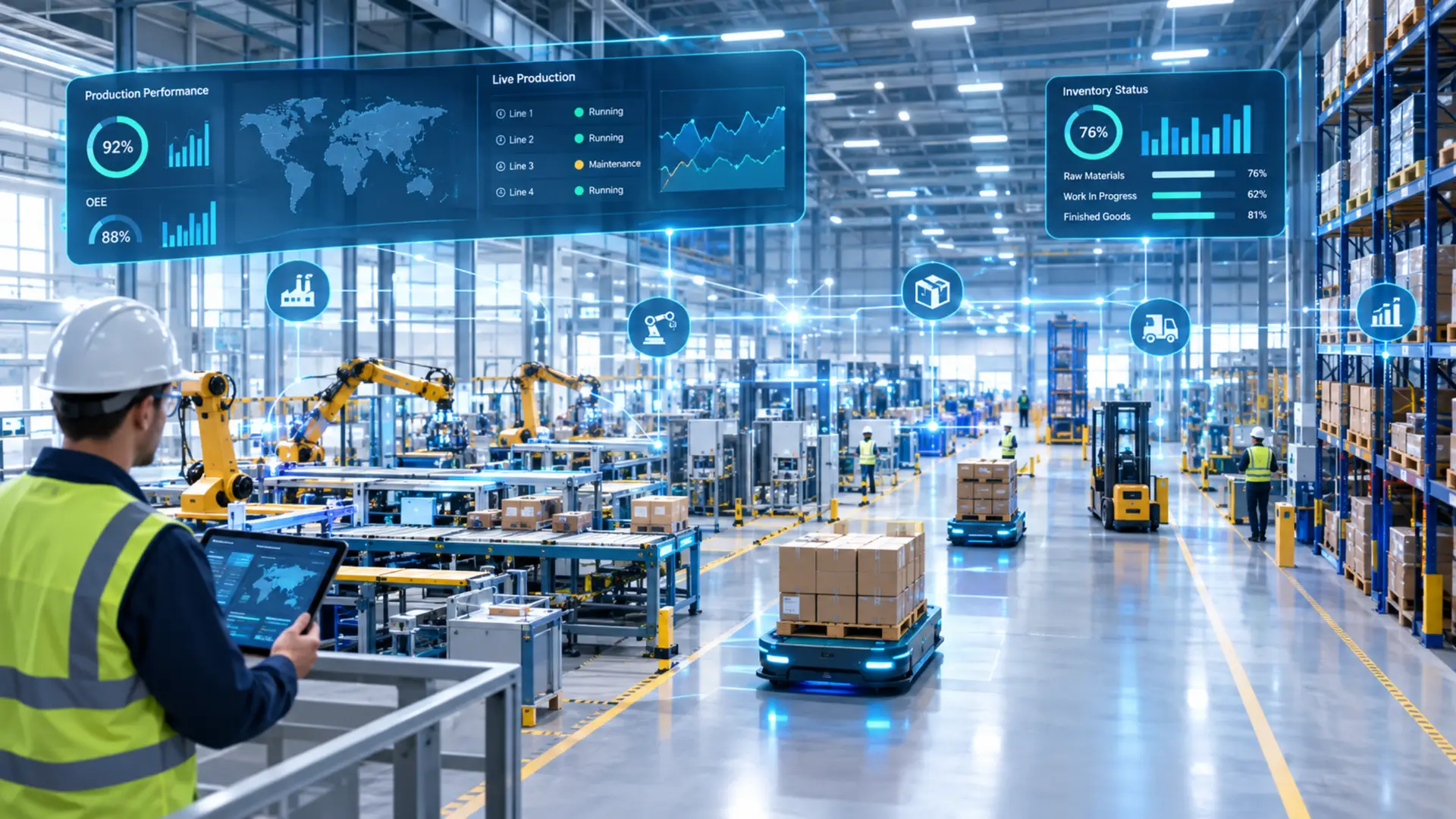
Authored by Meghana Nekar, SAP Digital Manufacturing & Practice, Körber StelliumFor decades, the traditional Manufacturing execution system (MES) acted as the dependable workhorse of the shop floor. It tracked work-in-progress, enforced process steps, and captured quality metrics. But as factories race toward Industry 4.0, these monolithic, heavily customized, on-premises legacy systems are turning into technical debt.
With SAP scheduling the sunset of legacy platforms like SAP ME and SAP MII, global manufacturers face a turning point. Maintaining these legacy environments introduces operational risks, security vulnerabilities, and data silos. This reality is driving a massive wave of MES modernization across Process and Discrete manufacturing industries alike.
Legacy MES Modernization Challenges Manufacturers Need to Address
Transitioning away from a legacy footprint isn’t as simple as swapping out software. Organizations embarking on this journey typically encounter two critical bottlenecks:
- Avoiding the “Lift-and-Shift” Trap: Legacy MES environments are often warped by years of site-specific custom code. Attempting to recreate every custom script or custom table in a modern environment completely undermines the benefits of standardizing. Modernization requires a mindset shift from custom coding to configuration and extensibility.
- Bridging the IT/OT Divide: Aligning corporate IT infrastructure with physical plant floor operational technology (OT) remains complex. Ensuring that edge devices, PLCs, and time-sensitive machine data communicate reliably with the enterprise layer requires rigid architectural design.
Why Manufacturers are moving to SAP DM
To bypass these legacy roadblocks, forward-thinking enterprises are choosing SAP DM (SAP Digital Manufacturing). As a modern cloud-based MES hosted on the SAP Business Technology Platform (SAP BTP), it changes how operations are managed.
1. Global Scalability & Lower Total Cost of Ownership
Unlike on-premise systems that demand localized hardware upkeep and tedious plant-by-plant rollouts, a Cloud based MES deploys globally from a centralized platform. Upgrades are pushed seamlessly by SAP, allowing plants to stay continuously compliant and up to date without costly engineering overhead.
2. Intelligent Automation and Execution
Through its integrated Production Process Designer, SAP DM replaces complex middleware with graphical workflow designs. This enables native automation across multiple shop-floor systems, coordinating tasks between operators, and production machinery with minimal latency.
Scheduling operations based on theoretical capacity is a recipe for bottlenecks. SAP DM uses real-time shop floor as actual tool availability, material staging alerts, and operator skill certification to dynamically optimize and schedules.
3. Advanced Resource Orchestration
Scheduling operations based on theoretical capacity is a recipe for bottlenecks. SAP DM uses real-time shop floor as actual tool availability, material staging alerts, and operator skill certification to dynamically optimize and schedules.
4. Cloud scalability for long-term data growth
As manufacturing data grows exponentially through machines, sensors, quality inspections, and production records, traditional on-premise MES platforms become increasingly expensive to scale. Organizations must continuously invest in servers, storage, backups, disaster recovery, and infrastructure maintenance. SAP Digital Manufacturing, built on SAP Business Technology Platform (SAP BTP), provides elastic cloud scalability where storage and compute can grow with business demand, reducing long-term infrastructure costs while improving performance.
5. An AI-ready manufacturing data foundation
Data managed within SAP BTP is well positioned for future AI initiatives. By centralizing operational, production, quality, and equipment data on the platform, manufacturers create an AI-ready foundation that can be leveraged for predictive maintenance, quality prediction, production optimization, intelligent scheduling, and generative AI assistants without extensive data migration.
6. Simplified Shop-Floor and Industrial Connectivity
SAP Digital Manufacturing supports multiple industrial connectivity options including OPC UA and MQTT, enabling secure communication with PLCs, machines, sensors, and IoT devices. These native connectivity capabilities reduce dependence on complex middleware, simplify shop-floor integration, and accelerate implementation while improving reliability.
7. Building a Future-Proof Manufacturing Environment
Modernizing from legacy MES is not only a technology upgrade but also an investment in long-term innovation. Cloud-native architecture, continuous SAP innovations, AI readiness, and flexible connectivity empower manufacturers to respond faster to changing business needs and Industry 4.0 initiatives.
For a broader view of how SAP DM supports Industry 4.0 initiatives, explore our perspective on digital transformation with SAP Digital Manufacturing. Connecting Shop-Floor Execution with SAP ERP
Historically, the connection between enterprise resource planning (ERP) and plant execution systems relied on complex, brittle middleware interfaces. A major technical differentiator for SAP DM is its out-of-the-box
This direct digital thread unifies master data across the entire enterprise. When a production order is released or modified at the ERP level, it updates on the operator’s Production Operator Dashboard (POD) instantly. Conversely, consumption, yield, scrap, and quality deviations recorded on the shop floor flow back into the ERP in near-real-time, giving executives an accurate view of operational costs and inventory.
Customer MES Modernization Experience: From Data to Value
Organizations that have transitioned away from localized legacy setups report measurable improvements across their supply chains.
From Production Data to Faster Operational Decisions
Instead of reacting to bad batches hours after production, manufacturers leveraging embedded analytics and AI-driven quality tracking can halt lines the moment a deviation occurs.
By moving away from paper-based tracking, plants have drastically reduced human data entry errors and minimized batch release cycle times. Ultimately, these modernization experiences show that upgrading your execution system is no longer just an IT software project—it is a foundational strategy to build a responsive, data-driven smart factory.
Greenfield SAP Digital Manufacturing Implementation
A great example of this is Körber Stellium’s experience with greenfield SAP DM implementations. By setting up SAP Digital Manufacturing alongside the construction of brand-new factories, Körber Stellium helps companies build a modern, cloud-first digital foundation from day one—making sure the tech and the physical shop floor are perfectly aligned before production even starts
Ready to Move Beyond Legacy MES?
Moving from legacy MES is not just a system replacement. It is an opportunity to simplify architecture, improve shop-floor connectivity, and build a more scalable foundation for future manufacturing operations. Körber Stellium brings hands-on experience helping manufacturers implement SAP Digital Manufacturing in real production environments.
Körber Stellium brings real-world SAP Digital Manufacturing implementation experience across live manufacturing environments. Talk to our experts!