

Authored By: Divesh Bali, Supply Chain Planning & Business Consulting at Körber Stellium
In today’s business environment, uncertainty is no longer an occasional challenge, it has become the new normal. Volatile customer demand, geopolitical disruptions, inflationary pressures, shorter product life cycles, and rising expectations for faster order fulfillment are forcing organizations to rethink the way they plan their supply chains.
Traditionally, demand planning relied heavily on historical sales data and statistical forecasting models to predict future demand. While these methods proved effective in relatively stable markets, they often struggle to keep pace with rapidly changing demand patterns driven by market volatility, promotions, supply disruptions, or evolving consumer behavior.
As a result, demand planning has evolved from being a forecasting exercise into a strategic business capability. Modern planning combines artificial intelligence, machine learning, real-time business signals, and cross-functional collaboration to enable faster, more accurate, and more responsive decision-making. Rather than simply predicting demand, organizations are now focused on sensing change early, evaluating business scenarios, and proactively responding before disruptions impact customers.
This is where SAP Integrated Business Planning (SAP IBP) has become a game changer. By bringing together demand planning, supply planning, inventory optimization, and Sales & Operations Planning (S&OP) on a single, integrated platform, SAP IBP enables organizations to align demand with supply, improve forecast accuracy, optimize inventory, and make data-driven decisions across the entire supply chain.
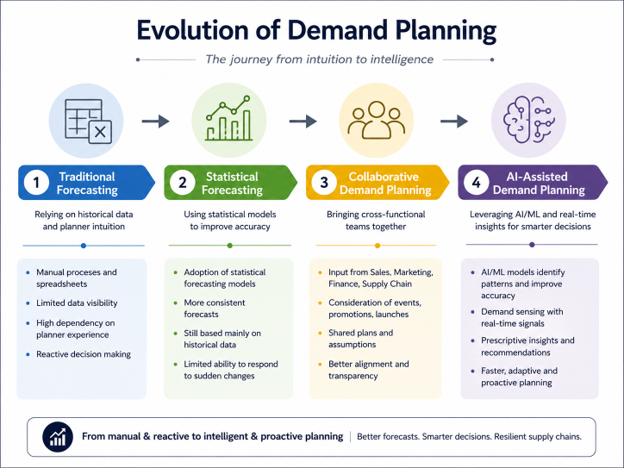
How Has Demand Planning Evolved from Forecasting to Intelligence?
Demand planning has undergone significant transformation over the last few decades.
1. Traditional Forecasting: Historical Data and Planner Experience
Earlier planning processes relied heavily on spreadsheets, historical sales data, and planner experience. Forecasts were usually generated monthly, and planners spent considerable time manually collecting, validating, and consolidating data from multiple systems.
While this approach worked reasonably well in predictable markets, it introduced several challenges
- Heavy dependence on historical data
- Limited visibility into market changes
- Manual planning activities
- Slow response to demand fluctuations
- Poor collaboration across departments
2. Statistical Forecasting: More Consistent Forecast Models
As planning solutions matured, businesses began adopting statistical forecasting techniques such as Moving Average, Holt-Winters, Croston and Seasonal Forecasting. While these techniques improved consistency, they still depended heavily on historical demand patterns and offered limited adaptability during unexpected market events.
3. Collaborative Demand Planning: Cross-Functional Business Input
Organizations soon realized that historical sales data alone could not explain future demand.
Business input from Sales, Marketing, Finance, Product Management, and Supply Chain became equally important in creating a reliable forecast. Collaborative planning introduced structured review cycles where statistical forecasts were refined using market intelligence, promotional plans, customer commitments, and business assumptions.
This marked an important shift from generating forecasts based solely on historical data to creating business-driven demand plans.
4. AI-Assisted Demand Planning: Intelligent Forecast Recommendations
Today, demand planning is becoming increasingly intelligent.
Artificial Intelligence and Machine Learning help planners by
- Identifying demand patterns
- Detecting anomalies
- Learning from historical behavior
- Improving forecast accuracy
- Providing automated forecast recommendations
Rather than replacing planners, AI supports better decision-making by allowing planners to focus on business exceptions instead of manually adjusting thousands of forecasts.
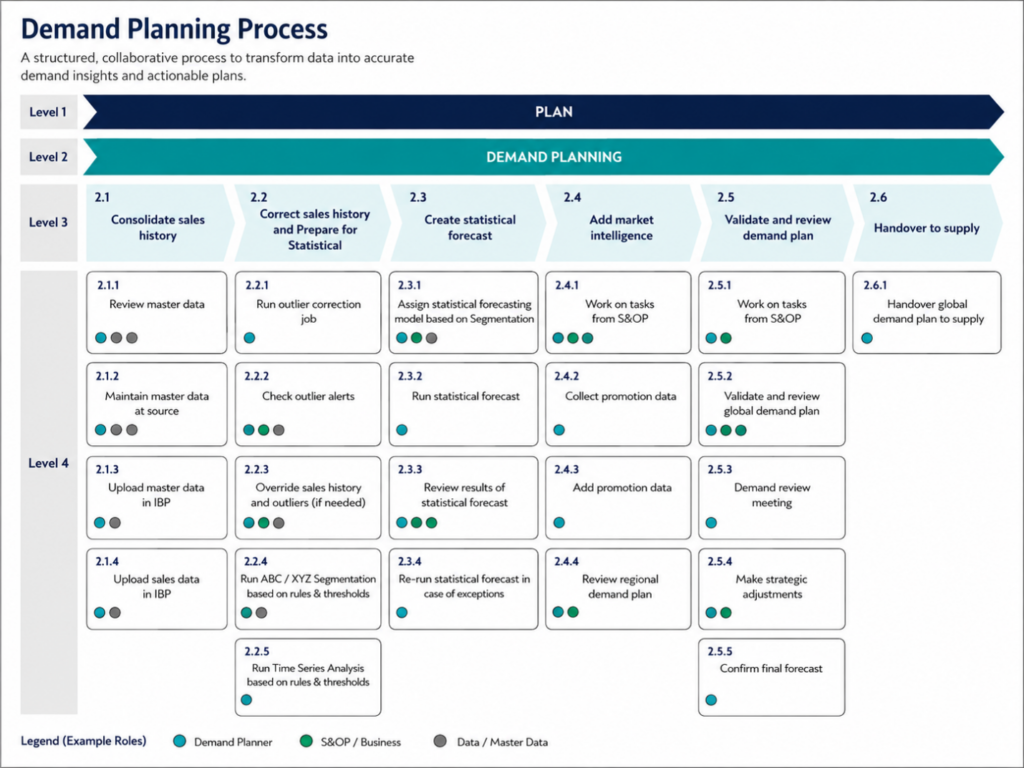
How Does the Traditional Demand Planning Process Work?
Traditional demand planning is primarily based on historical sales data, statistical forecasting models, and planner expertise to estimate future demand. The process involves consolidating historical data, cleansing sales history, generating statistical forecasts, incorporating market intelligence such as promotions and business inputs, and validating the forecast through collaborative S&OP meetings before handing it over to Supply Planning. While effective in stable market conditions, the process is often reactive and depends heavily on manual analysis and periodic forecast updates.
Why Traditional Demand Planning is No Longer Enough
Despite advances in planning technology, many organizations continue to face similar challenges during implementation projects.
Poor Master Data Quality Reduces Forecast Reliability
One of the most common issues is poor master data quality. Inaccurate product hierarchies, duplicate materials, inconsistent customer information, and incomplete historical data significantly reduce forecast reliability before planning even begins.
Limited End-to-End Visibility Delays Planning Decisions
Another challenge is limited end-to-end visibility. Demand planners often have little insight into inventory positions, production constraints, supplier limitations, or customer-specific demand changes, making it difficult to balance service levels with inventory costs.
Fragmented Planning Creates Conflicting Forecasts
Planning also remains highly fragmented in many organizations. Sales, Finance, Procurement, Manufacturing, and Supply Chain frequently work with different versions of the forecast, resulting in conflicting priorities and delayed decision-making.
Manual Spreadsheet Work Slows Demand Planners
In addition, many planning teams continue to spend valuable time downloading reports, consolidating spreadsheets, manually adjusting forecasts, and sharing files across departments. Instead of improving forecast quality, planners often become data administrators.
Market Volatility Outpaces Traditional Planning Cycles
Finally, market volatility has increased significantly. Consumer behavior, promotions, regulatory changes, geopolitical events, and supply disruptions can alter demand patterns within days, while traditional planning cycles typically react much more slowly.
How SAP IBP Improves Forecast Accuracy
SAP IBP addresses these challenges by integrating people, processes, data and AI on a single planning platform.
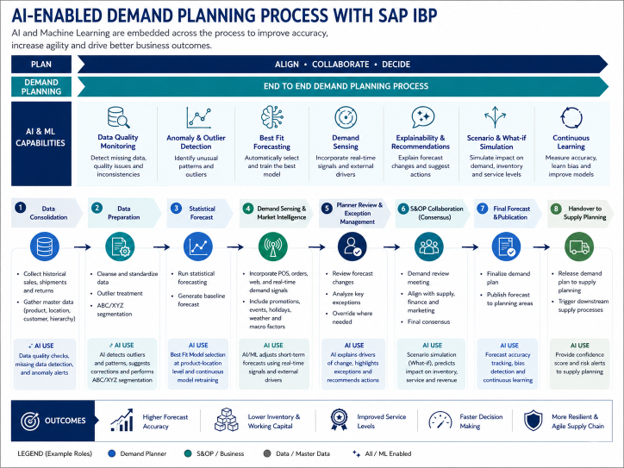
AI-Enabled Demand Planning with SAP IBP
AI-enabled demand planning enhances the traditional process by embedding Artificial Intelligence and Machine Learning across every stage of planning. In addition to historical data, AI continuously analyzes real-time demand signals, automatically detects anomalies, selects the best-fit forecasting models, performs demand sensing, explains forecast changes, and recommends actions for planners. This enables organizations to improve forecast accuracy, respond faster to market changes, simulate business scenarios, and create a more resilient, agile, and data-driven supply chain.
AI and Machine Learning-Based Forecasting
One of SAP IBP’s strongest capabilities is its ability to combine traditional statistical forecasting with Machine Learning.
Instead of applying a single forecasting technique across an entire product portfolio, SAP IBP automatically evaluates multiple forecasting models and recommends the best-fit approach based on historical demand behavior.
This significantly improves forecast accuracy while reducing the manual effort required to maintain forecasting models.
Demand Sensing for More Accurate Short-Term Forecasts
Traditional forecasting primarily relies on historical sales data.
Demand sensing takes forecasting a step further by incorporating near real-time demand signals such as customer orders, shipments, point-of-sale data, weather conditions, promotions, and external market indicators.
By continuously evaluating these signals, organizations can react much faster to changing market conditions and improve short-term forecast accuracy.
Cross-Functional Collaboration for Better Forecast Alignment
Successful demand planning is not owned by a single department.
SAP IBP enables Sales, Marketing, Finance, Procurement, Manufacturing, and Supply Chain teams to collaborate using the same planning data instead of maintaining multiple disconnected spreadsheets.
This creates a single version of the truth and significantly improves alignment during the Sales and Operations Planning (S&OP) process.
Scenario Planning for Proactive Risk Management
One of the capabilities that clients consistently find valuable during SAP IBP implementations is scenario planning.
Business leaders frequently ask questions such as:
- What happens if demand increases by 20%?
- What if a critical supplier becomes unavailable?
- What if production capacity is reduced?
- What if a promotion performs significantly better than expected?
Instead of making assumptions, SAP IBP allows organizations to simulate these scenarios before making operational decisions, helping businesses proactively manage risks rather than reacting after disruptions occur.
End-to-End Visibility for Faster Planning Decisions
Because SAP IBP integrates Demand Planning, Supply Planning, Inventory Optimization, and Response Planning on a common platform, planners gain complete visibility across the supply chain.
Potential inventory shortages, supply constraints, capacity limitations, demand spikes, and service-level risks can be identified much earlier, enabling faster and more informed decision-making.
Traditional vs. AI-Enabled Demand Planning: What Is the Difference?
| Traditional | AI Enabled |
| Historical Sales | Historical + Real-time Signals |
| Monthly Forecast | Continuous Forecast |
| Manual Analysis | AI Recommendations |
| Reactive | Predictive |
| Spreadsheet | SAP IBP |
| Single Forecast | Scenario Planning |
| Planner Driven | Planner + AI |
Which KPIs Measure Demand Planning Performance?
Successful demand planning should always be measured using business outcomes rather than system usage.
Some of the Industry standard KPIs include:
| KPI | Business Value |
| Forecast Accuracy | Measures forecasting reliability |
| Forecast Value Add (FVA) | Evaluates planner contribution |
| Forecast Bias | Detects consistent over- or under-forecasting |
| Service Level | Measures of customer fulfillment performance |
| Inventory Turns | Evaluates inventory efficiency |
| Stockout Rate | Indicates product availability |
| Planning Cycle Time | Measures planning efficiency |
| Inventory Value | Tracks working capital utilization |
Best Practices for a Successful SAP IBP Implementation
Technology alone cannot transform demand planning. Successful implementations generally focus on the following principles:
Build a Strong Data Foundation -High-quality master data remains the single biggest contributor to forecast quality.
Match Forecasting Models to Demand Patterns-Different products require different forecasting techniques.Fast-moving products, intermittent demand, and seasonal products should not be forecast using the same statistical model.
Establish Cross-Functional Planning Ownership -Demand planning should never be viewed solely as a supply chain activity.The best forecasts are created when business stakeholders actively participate in the planning process.
Measure Forecast Value and Improve Continuously -Forecast accuracy should not be the only success metric.Organizations should regularly review forecast bias, planner interventions, and Forecast Value Add (FVA) to ensure continuous improvement.
Prioritize User Adoption and Change Management– Even the best planning solution delivers limited value if planners continue working offline in spreadsheets. Effective training, governance, and change management are essential for long-term success.
From Reactive Forecasting to Resilient Supply Chain Planning
Modern demand planning is no longer just about predicting future demand, it’s about enabling smarter business decisions. By combining AI-driven insights with business expertise and integrated planni ng processes, organizations can move from reactive forecasting to proactive decision-making. Solutions like SAP IBP help bridge this transformation, allowing businesses to improve forecast accuracy, optimize inventory, and build resilient supply chains that can confidently adapt to an ever-changing market.
Build a More Resilient Demand Planning Process with SAP IBP
Improve forecast accuracy, strengthen cross-functional planning, and respond faster to changing demand with an integrated SAP IBP strategy. Explore how Körber Stellium can help you design, implement, and optimize SAP IBP for measurable supply chain outcomes.
Explore SAP IBP Solutions | Talk to Our Supply Chain Planning Experts