Authored by Anoop Prasad | Technical Insights on SAP Digital Manufacturing, Körber Stellium
Connected manufacturing enables real-time operational excellence.
Introduction: From connected systems to real-time executions
Manufacturers across industries are racing to become “smart factories” – plants where machines, MES, and ERP are connected end to end, data flows in near real time, and execution decisions are driven by facts captured at the point of action. From a technical standpoint, this comes down to three integrated layers: S/4HANA as the planning and system of record layer, SAP Digital Manufacturing (SAP DM) as the execution layer, and a plant-connectivity layer that bridges shop-floor devices into that execution layer.
This article takes a functional and technical look at how those three layers fit together – the architecture, the key interfaces, the master data objects involved, and the integration patterns used to connect machines, scales, and scanners to SAP DM and, through it, to S/4HANA.
SAP DM Smart Factory Reference Architecture
A typical SAP DM Smart Factory landscape is composed of the following layers:
| Layer | Role & Components |
| S/4HANA (On – Premise or Cloud) – PP/QM/EWM | Process/production orders, routings and recipes, master recipes, work centers/resources, material masters, batch master data, inspection plans. Source of planning and the system of record for cost and inventory. |
| Integration Layer | Standard SAP DM – S/4HANA integration content (typically via SAP Integration Suite or direct OData / IDoc – based interfaces) for order replication, confirmations, and goods movement posting, with master data sync. |
| SAP Digital Manufacturing (Cloud, SAP BTP) | Order execution, operator workflows, quality and genealogy, real – time KPIs. Built on a microservices architecture with extensibility via SAP DM using BTP and OData/REST APIs. |
| Plant Connectivity / Edge Layer | SAP Production Connector / SAP PCo or equivalent edge gateway translating shop floor protocols (OPC UA/DA, MQTT, Modbus TCP, proprietary scale/scanner protocols) into structured messages for SAP DM. |
| Shop Floor Devices | PLCs, weighing scales (e.g., Mettler Toledo), barcode/QR scanners, operator terminals (HTML5 – based DM clients), and vision or sensor systems feeding execution and quality data. |
The architectural principle that matters most in practice is keeping each layer doing what it does best: S/4HANA stays the system of record for planning, cost, and inventory; SAP DM owns execution, guided workflows, and shop-floor analytics; and the connectivity layer absorbs protocol diversity so neither S/4HANA nor SAP DM has to deal directly with device-level signals.
S/4HANA Master Data and Order Objects in Scope
Getting SAP DM execution to align with S/4HANA planning depends on a defined set of master data and transactional objects being replicated and kept in sync:
- Work centers and Resources – mapped to SAP DM work centers/equipment to align capacity and execution
- Routings, Master recipes, and BOMs – the source for operation sequences, phases, and component/quantity requirements executed in SAP DM
- Process/Production Orders – Released in S/4HANA and replicated to SAP DM as executable order structures
- Material and Batch master data – including batch classification and shelf-life data needed for FEFO and genealogy logic
- Inspection plans and characteristics – linked to operations for in-line quality checks during confirmation
Order release in S/4HANA is the typical trigger point: once an order is released, its header, operations, and component data are pushed into SAP DM, where it becomes an executable unit on the operator’s worklist.
Integration Interfaces: S/4HANA and SAP DM
The S/4HANA – SAP DM integration is bi-directional and event-driven, typically implemented through SAP Integration Suite or standard pre-delivered integration content. The key interface patterns are:
| Interface | What Flows & How |
| Order Replication (S/4HANA → SAP DM) | Process/Production orders, Operations, and BOM/Recipe data pushed into SAP DM as executable order structures, typically near real time on order release. |
| Confirmation & Goods Movement Posting (SAP DM → S/4HANA) | Activity confirmations, Quantity confirmations, Goods issues/receipts, and Quality results posted back to update order status, inventory, and costs – usually within seconds of operator action. |
| Master Data Sync | Bill of Materials, Work centers, resources, materials, batches, and inspection characteristics synchronized on a scheduled or event-driven basis to keep execution data aligned with the ERP system of record. |
| Machine/Device Data Capture | Scale weights, scan events, and PLC signals captured via Production Connector / PCo or Edge adapters and mapped to SAP DM operations – driving automated confirmations and reducing manual keying. |
| Analytics & Downstream Consumption | OData services and embedded dashboards expose execution KPIs to SAP Analytics Cloud or third-party BI tools for plant and corporate-level reporting. |
In practice, confirmation posting is the interface that carries the most operational weight: every activity confirmation, quantity confirmation, and goods movement triggered on the shop floor needs to land in S/4HANA reliably and in sequence, since it directly affects order status, inventory, and order costing. Idempotency and error-queue monitoring on this interface are critical design considerations, not afterthoughts.
Shop-Floor Machine Integration with SAP DM
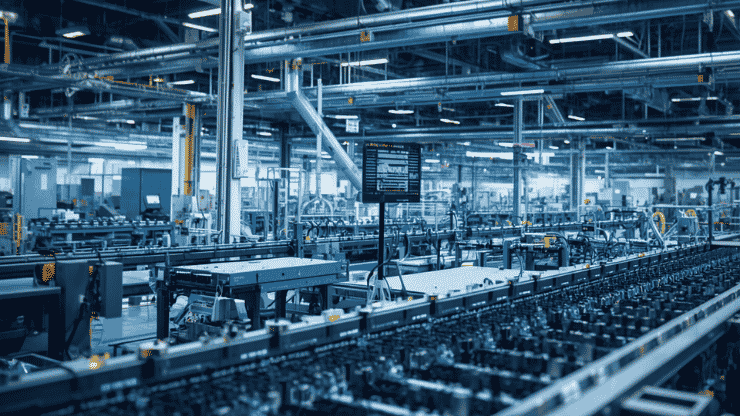
Machine and device integration is where a Smart Factory initiative either delivers on its promise or stalls. SAP DM does not talk to PLCs and scales directly – it relies on an Edge / Connectivity layer, most commonly Production Connector, to normalize device-level signals into structured messages:
- Protocol adapters OPC UA/DA, MQTT, and Modbus TCP adapters connect to PLCs, SCADA, and Historians without requiring custom point-to-point code
- Device-specific integration – weighing scales (e.g., Mettler Toledo), Barcode/QR scanners, and label printers are integrated through dedicated drivers or serial/TCP interfaces at the edge
- Message mapping – Raw tag/signal data is mapped to SAP DM operation and resource context, so a scale reading or scan event is automatically associated with the correct order, operation, and material
- Buffering and resilience – the Edge layer buffers data during connectivity loss and forwards once the link to SAP DM cloud is restored, protecting against data loss during network interruptions
- Automated confirmations – Validated device data can trigger system confirmations directly, removing manual operator data entry and the errors that come with it
This layer is also where most Smart Factory accelerators live: digital BOM-based mixing via integrated scales, QR-based material/batch/scale selection, and milestone-based phase automation are all built on top of this device-integration foundation, not as separate point solutions.
Common Smart Factory Implementation Challenges
No two plants start from the same place, but recurring technical and functional themes show up across customer engagements:
| Challenge | How SAP DM Addresses It |
| Fragmented systems and Data silos across PLCs, SCADA, MES, and ERP | Standardize SAP DM as the execution layer, integrated to S/4HANA PP/QM/EWM via standard order/confirmation interfaces and to the floor via Production Connector/Edge connectivity. |
| Limited real-time visibility into production | Capture confirmations, quantities, and quality data at the point of execution via device integration, eliminating shift-end batch uploads. |
| Heavy reliance on manual, paper-based processes | Replace paper forms with guided, digital operator workflows enforced through configurable business rules and validations. |
| Difficulty scaling proven processes across plants | Use templated master data, reusable integration adapters, and a multi-tenant cloud architecture to roll out consistent processes from site to site. |
| Latency or protocol mismatch between legacy machines and cloud MES | Use SAP Production Connector / PCo as a protocol-translation layer (OPC UA/DA, MQTT, Modbus) at the Edge – buffering and forwarding data to SAP DM cloud services. |
Beyond technology, the less visible challenges are often the deciding factor: master data quality, alignment between IT and operations, and getting operator buy-in for a new way of working. Plants that treat these as core workstreams – not afterthoughts – tend to see faster, more durable adoption.
SAP DM Capabilities That Drive Smart Factory Outcomes
SAP Digital Manufacturing brings together execution, integration, and analytics on a single cloud platform. The capabilities that consistently deliver the most value include:
| Capability | What It Delivers |
| Order & Operation Execution | Order-to-operation breakdown driven by routings/recipes replicated from S/4HANA, with digitized Work instructions, electronic signatures, and real-time Activity, Quantity, and Time confirmations posted back via standard interfaces. |
| Machine & Shop-Floor Integration | Plant connectivity through SAP Production Connector / PCo or SAP Digital Manufacturing’s native Edge integration, supporting OPC UA, MQTT, and REST adapters to PLCs, Scales, Scanners, Vision systems, and Historians. |
| Quality & Genealogy | Inspection plans and characteristics tied to operations, in-line quality checks at confirmation, and full pack/unpack genealogy down to raw material batch and equipment/resource used. |
| Real-Time Visibility & Analytics | Embedded analytics (OEE, Yield, Scrap, Downtime, Throughput, Cycle time) built on the same execution data model, exposed via dashboards and OData services for downstream SAP Analytics Cloud or BI Tools. |
| Cloud-First, Extensible Architecture | SAP BTP-based microservices architecture with configurable business rules, custom apps via SAP DM using BTP, and standard APIs for extending execution logic without core modifications. |
What stands out across these capabilities is that SAP DM is not just a reporting layer bolted onto existing processes. It actively shapes execution – guiding operators, validating inputs at the point of action, and feeding clean, granular data back into S/4HANA in near real time via the interfaces described above.
Business Outcomes from SAP Digital Manufacturing
Organizations that have implemented SAP DM as part of a broader Smart Factory initiative typically report improvements such as:
- Real-time visibility into Batch and Order status, replacing shift-end or next-day reporting
- Fewer execution errors through guided, validated operator workflows
- Stronger end-to-end traceability from raw material to finished, packed goods
- Faster detection of quality and material issues, with less dependency on supervisor escalation
- A scalable execution framework that can be extended to additional plants without rebuilding from scratch
The common thread is a shift from reactive reporting to proactive, execution-level decision-making – without disrupting the realities of running a live plant.
Technical Lessons Learned from SAP DM implementations
Across implementations, a few practical, technically grounded lessons hold up regardless of industry or plant size:
Integration Suite Landscape
A two-tenant setup within the Integration Suite is required, with separate environments for SAP DM Production (PRD) and SAP DM Quality Assurance (QAS). This ensures stable operations across the systems.
Production Connector Capacity for Shopfloor Equipment
A single production connector can effectively support up to 50 shopfloor equipment units (e.g., weighing scales, filling machines). In high-volume dairy plants with multiple processing and packaging lines, additional connectors are required to maintain performance and avoid latency during peak operations.
Initial Inventory Load & Synchronization
The factories are already using S/4 systems and remains active; a custom transaction needs to be developed to load and synchronize existing initial inventory in SAP DM from SAP S/4HANA using inventory consolidation mode.
Enhanced User Interface for Shopfloor Operations
Custom responsive user interfaces need to be developed by extending standard services to simplify shopfloor activities such as formulation, batching, and packaging. This improves operator efficiency and reduces manual errors in fast-paced environments.
External Data Storage for Shopfloor Customization
Due to public cloud limitations restricting direct database access, an external database needs to be integrated (optional depending upon business requirement) to manage custom shopfloor data (e.g., operator attributes, consumption parameters). This supports better traceability and reporting
Centralized User Management
A unified user management approach needs to be implemented across SAP BTP, SAP DM, and Cloud Identity Services (CIS), ensuring consistent access control for operators, supervisors, planners and quality personnel.
Final takeaway for Smart Factory rollouts
A Smart Factory built on SAP DM is, at its core, an integration architecture: S/4HANA for planning and system-of-record data, SAP DM for guided execution and shop-floor analytics, and a connectivity layer that turns raw machine signals into structured, contextualized transactions. Getting the technical foundation right – clean master data mapping, resilient interfaces, and a properly architected edge/connectivity layer – is what determines whether real-time visibility and automated execution materialize on the floor.
For manufacturers planning an SAP DM rollout, the most successful technical teams treat S/4HANA integration and shop-floor machine connectivity as first-class design workstreams from day one, not integration tasks to be solved late in the project.
Turn Your Smart Factory strategy into a scalable SAP DM roadmap
If your manufacturing teams are planning an SAP Digital Manufacturing rollout or looking to modernize legacy MES, MII, or shop-floor execution processes, Körber Stellium can help assess your current landscape, integration readiness, and plant-level automation opportunities.
Explore our SAP Digital Manufacturing solutions to see how we support connected manufacturing execution, S/4HANA integration, and scalable shop-floor transformation.