

Authored By Meenakshi Shankar & Verified by Anirban Majumdar, Supply Chain Planning & Business Consulting at Körber Stellium
Why supply planning is critical during disruptions
Supply chains in organizations are increasingly facing frequent disruptions arising from geopolitical tensions, climate change, volatile customer demand, inflationary pressures, shorter product lifecycles, and many other uncontrollable factors. Organizations therefore have to constantly rethink how they are planning and executing their supply chains.
A robust supply planning and execution strategy helps manufacturers optimize production schedules, control material costs, and avoid process backlogs. Effective supply planning coordinates production and distribution to meet demand, minimizes costs, and builds a dependable operation. Companies reported that the main consequences of disruptions were financial, logistics, and reputation. And with businesses now facing a 14% year-on-year increase in the number of disruptive supply chain events, more and more of these businesses are likely to be hit by volatility. Effective supply planning strategies therefore become extremely important for organizations.
Five Supply Planning Strategies to Strengthen Resilience
Manufacturing companies can improve their organizational resilience by adopting one or more of the following strategies to enhance agility, reduce operational risks, and maintain product availability even during supply chain disruptions.
- Demand-Driven Supply Planning
Use real-time demand signals and advanced forecasting tools to quickly adjust production and procurement plans as market conditions change. - Build Strategic Inventory Buffers
Maintain safety stock for critical materials and high-demand products to reduce the impact of supply shortages and unexpected disruptions. - Diversify Supplier Networks
Source key materials from multiple suppliers and regions to minimize dependency on a single supplier and improve supply chain resilience. - Leverage Integrated ERP and Supply Chain Systems
Connect procurement, production, inventory, and distribution data through integrated platforms to gain visibility and make faster, data-driven decisions. - Adopt Scenario Planning and Risk Management
Regularly model potential disruption scenarios, such as supplier delays or demand surges, and develop contingency plans to ensure business continuity.
While these strategies are well known and understood, the key is to have a cohesive and coordinated approach and process capability to execute these strategies to ensure maximum impact. A mature and robust planning tool like SAP’s Integrated Business Planning (IBP) can greatly help in carrying out these planning strategies.
How SAP Integrated Business Planning – Enables Resilient Supply Planning
SAP Integrated Business Planning (IBP) solution connects your demand forecast to actionable, real-time supply plans. It uses advanced algorithms to translate sales and production requirements into feasible purchasing, manufacturing, and distribution plans across your entire network, keeping costs and capacity limits in check.
End-to-End Planning Process in SAP IBP
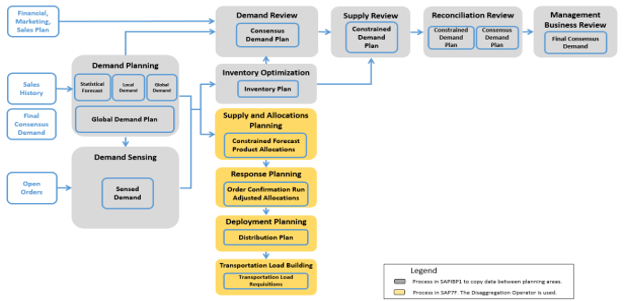
How SAP IBP Supports Key Planning Strategies
SAP Integrated Business Planning (SAP IBP) directly supports each of the supply planning strategies through its demand planning, supply planning, inventory optimization, control tower, and analytics capabilities. Here’s how each strategy maps to SAP IBP functionality.
| Supply Planning Strategy | How SAP IBP Helps | Key SAP IBP Capabilities |
| 1. Demand-Driven Planning | SAP IBP continuously aligns supply plans with changing demand using statistical forecasting, machine learning, and near real-time demand sensing. Planners can rapidly evaluate changes and rebalance supply through scenario simulations. | Demand Planning Demand Sensing ML-based Forecasting Response & Supply PlanningWhat-if Simulations |
| 2. Build Strategic Inventory Buffers | SAP IBP determines optimal inventory targets and safety stock levels by balancing service levels, demand variability, and supply uncertainty. It continuously recalculates inventory policies as business conditions evolve. | Multi-Echelon Inventory Optimization (MEIO), Service Level Optimization, Safety Stock Planning |
| 3. Diversify Supplier Networks | SAP IBP enables planners to model multiple sourcing options, supplier capacities, lead times, and constraints. During supply disruptions, alternative sourcing scenarios can be evaluated to identify the best response while minimizing cost and service impact. | Supply PlanningResponse ManagementSource-of-Supply modellingConstraint-Based PlanningScenario Planning |
| 4. Leverage Integrated ERP and Supply Chain Systems | SAP IBP integrates with SAP S/4HANA, SAP ERP, SAP Ariba, SAP Integrated Business Planning Control Tower, and other enterprise systems to provide a single, consistent planning environment. This enables end-to-end visibility across procurement, manufacturing, inventory, and distribution. | Real-Time Integration with SAP S/4HANASAP Cloud Integration, Unified Planning Data Model, Supply Chain Control Tower, Analytics & Dashboards |
| 5. Adopt Scenario Planning and Risk Management | SAP IBP allows planners to create multiple planning scenarios, simulate disruptions such as supplier failures, capacity shortages, or demand spikes, compare outcomes, and select the most effective mitigation strategy before implementing changes. | What-if Scenario PlanningVersion ManagementResponse & Supply Planning Supply Chain Control Tower Predictive Analytics & Alerts |
Business Benefits of SAP IBP for Supply Chain Resilience
SAP IBP enables organizations to execute these strategies by providing:
- Better demand responsiveness through AI-assisted forecasting and demand sensing.
- Optimized inventory that balances working capital with service levels.
- More resilient supply networks through alternative sourcing and constraint-based planning.
- End-to-end visibility by integrating planning data across ERP, procurement, manufacturing, and logistics.
- Proactive risk management using simulations, exception alerts, and scenario analysis to prepare for disruptions before they occur.
Conclusion: From Disruption Response to Competitive Advantage
With its end-to-end planning capabilities, SAP IBP serves as an integrated planning platform that connects each planning strategy in a single planning environment instead of addressing each strategy independently. This enables organizations to make faster, more informed, and more resilient supply chain decisions that can turn into a distinct competitive advantage in the dynamic marketplace.
Build a More Resilient Planning Framework with SAP IBP Consulting
Effective supply planning requires more than technology. Körber Stellium helps organizations align planning processes, data, integrations, governance, and user adoption to turn SAP IBP strategy into executable business outcomes.
Connect with our SAP IBP experts to assess your planning priorities, identify capability gaps, and develop a roadmap for more resilient decision-making.