

Authored By Deepmala Burnwal, Supply Chain Planning & Business Consulting at Körber Stellium
Supply chain planning is no longer just an operational activity—it is a source of competitive advantage. Volatile demand, complex networks, and pressure to improve service while controlling working capital are raising the bar for how quickly and confidently businesses must make decisions. Organizations are moving away from people dependent processes to technology enabled automation to drive efficiencies and business competitiveness.
Many organizations are investing in advanced planning platforms powered by AI, demand sensing and optimization. Yet technology alone rarely delivers the expected impact. Sustainable results come when teams are aligned, processes are connected, accountability is clear, and insights translate into action.
A successful planning transformation is about more than implementing a system. It is about changing how the organization plans, collaborates and makes decisions.
Four pillars make this possible: People, Process, Technology and Governance. They are interconnected—and the strength of the transformation depends on how well they work together.
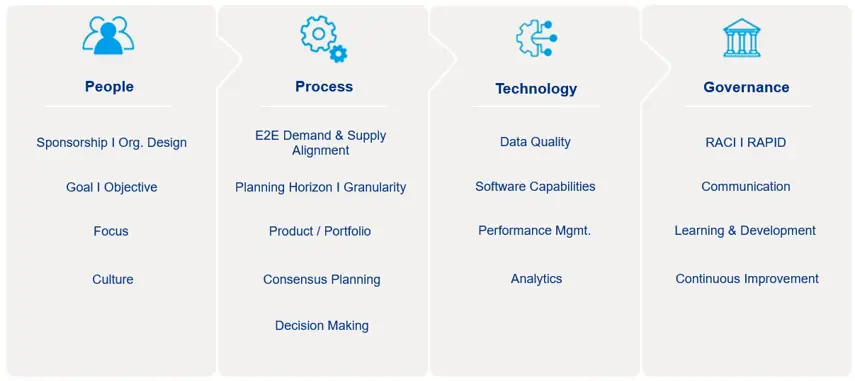
1. People: Sponsorship, Skills, and Change Adoption
People are what turns a planning design into a way of working. Teams need the skills, confidence, and trust to use the plan and act on it. Four areas deserve attention:
Sponsorship and organizational design
- Build visible leadership sponsorship by connecting the change to business priorities, expected outcomes and clear measures of success.
- Define roles and decision ownership across demand planning, supply chain, procurement, manufacturing, finance, sales and marketing.
- Make planning a cross-functional responsibility. For example, a meaningful demand plan brings together commercial insight, financial targets and supply constraints.
Goals and objectives
- Set measurable priorities—customer service, forecast accuracy, lower excess inventory, production stability and shorter planning cycles.
- Give each priority an owner and align functional targets to shared supply chain outcomes.
Focus and capability building
- Free planners from repetitive spreadsheet work and data gathering so they can focus on insights, scenarios, exceptions and decisions.
- Invest in analytical thinking, problem-solving and cross-functional collaboration—not only system training.
- Help users understand the planning logic, the business impact of recommendations and when human intervention is needed.
Culture and change adoption
- Bring stakeholders into the journey early through practical demonstrations, role-based learning and consistent communication.
- Continue supporting users after go-live, reinforcing the value of combining data-led recommendations with human judgment.
The ambition: create a culture where teams trust the planning process, challenge assumptions constructively and act on what they learn.
2. Process: Aligning Demand, Supply, and Business Decisions
A planning platform cannot fix a fragmented process. Automating disconnected ways of working simply accelerates existing problems. Start by designing the end-to-end planning cycle, clarifying decision points and connecting the functions involved.
End-to-end demand and supply alignment
Demand, supply, procurement, production and inventory plans need to work as one connected cycle. A forecast creates value only when it is tested against capacity, material availability, supplier lead times and inventory policies.
- Translate changes in demand into their supply and inventory implications.
- Identify capacity, material and supplier constraints before they disrupt execution.
- Align the relevant teams on corrective actions, owners and timelines.
Planning horizon and granularity
Set the planning horizon and level of detail according to the decisions the business needs to make:
- Strategic: shape long-term capacity, network design and investment decisions.
- Tactical: balance demand and supply, set inventory targets and allocate resources.
- Operational: manage near-term replenishment, production requirements and execution exceptions.
The right level of granularity depends on the product portfolio, demand variability and supply chain complexity. Excessive detail creates effort; insufficient detail can hide critical constraints.
Product and portfolio planning
One planning approach will not fit every product:
- Stable, high-volume products: use statistical forecasting and standard replenishment policies.
- Intermittent-demand products: apply forecasting methods suited to sporadic demand patterns.
- New products: combine commercial inputs, lifecycle assumptions and structured launch planning.
Segment the portfolio to tailor planning logic, review frequency, service expectations and inventory policies.
Cross-Functional Consensus planning
Create one shared view of demand, supply and financial impact by bringing the right functions into the conversation:
- Sales and marketing contribute customer and market insight.
- Supply chain validates operational feasibility and capacity.
- Procurement brings visibility into supplier capability and constraints.
- Finance connects planning choices to revenue, cost and profitability.
Use structured reviews to expose differences, evaluate trade-offs and agree a clear plan owner. Consensus does not require identical assumptions; it requires transparent assumptions and an understood decision.
Decision-making and Escalation
Define how the organization will respond when the plan is at risk—for example, when demand exceeds capacity or material availability becomes constrained.
- Establish decision triggers and clear escalation thresholds.
- Set review cadences and specify the information required to make decisions.
- Agree how alternatives will be assessed and priorities determined.
A well-designed process converts business signals into timely decisions and coordinated action.
3. Technology: Data Readiness, Planning Capabilities, and Analytics
Technology provides the data, visibility, analytics and automation that modern planning requires. The platform should be selected and configured to support business needs—not dictate them.
Data quality and readiness
Planning decisions are only as reliable as the data behind them. Common gaps include:
- Inaccurate product master data or inconsistent units of measure.
- Incorrect lead times or incomplete bills of material.
- Unreliable inventory records and gaps in historical data.
Make data readiness a core transformation workstream. Assign business owners, establish validation rules, resolve issues and monitor quality continuously. Data ownership does not end at go-live.
Planning Software capabilities
Choose a platform that addresses today’s priorities while supporting future planning needs. Relevant capabilities may include:
- Statistical forecasting and demand sensing.
- Integrated demand-supply balancing and inventory optimization.
- Capacity-aware planning.
- Scenario modelling and exception management.
Evaluate solutions against the factors that matter to the business:
- Alignment with business requirements and planning maturity.
- Integration with ERP and execution systems.
- Scalability, usability and implementation complexity.
- Total cost of ownership.
The most advanced platform is not automatically the right one. Prioritize a solution that supports the decisions the business needs to make—and that teams can realistically adopt and sustain.
Performance management and KPIs
Track a focused set of measures that connect planning effectiveness to business performance:
- Forecast accuracy and bias.
- Customer service and fulfilment levels.
- Inventory turns and days of inventory on hand.
- Plan adherence and planning cycle time.
Dashboards create visibility, but value comes from action: understanding what changed, identifying root causes and agreeing who will address them.
Advanced analytics and scenario planning
Analytics can uncover demand patterns, anticipate disruption, expose inventory imbalances and compare supply options. Scenario modelling helps decision-makers assess trade-offs such as:
- Customer service versus working capital.
- Production stability versus responsiveness to demand.
AI can surface patterns and generate insights. Its impact, however, depends on trusted data, fit-for-purpose processes, user confidence and clear decision ownership.
Technology creates the potential for better planning. People and process turn that potential into measurable business value.
4. Governance: Ensuring accountability, and Continuous Improvement in planning transformation
Governance keeps planning aligned and decisions moving. It establishes ownership, decision rights, escalation paths and performance reviews. Without it, even strong processes and capable platforms can produce conflicting plans and delayed action.
RACI and RAPID defining decision rights
- Use RACI to clarify who is Responsible, Accountable, Consulted and Informed.
- Use RAPID to define who Recommends, Agrees, Performs, provides Input and Decides.
Apply these frameworks to demand and supply reviews, inventory decisions, capacity allocation and executive IBP forums. When demand exceeds capacity, everyone should know who develops options, contributes input, makes the decision and executes it.
Communication and planning reviews
- Maintain a common planning calendar and consistent meeting agendas.
- Define the inputs, decisions and outputs expected from every review.
- Communicate decisions clearly and track actions through to closure.
Resolve operational issues at the appropriate level, while escalating strategic priorities and major trade-offs to leadership.
Learning and development
- Build capability through performance reviews, knowledge-sharing, targeted training and regular feedback.
- Turn lessons from deviations, overrides, missed targets and recurring exceptions into practical improvements.
- Make capability development an owned responsibility—not something that depends on a handful of experienced individuals.
Continuous improvement
Create a regular review rhythm across four areas:
- Process adherence and planning performance.
- Data quality and effective system usage.
- Business outcomes and value realization.
Address recurring issues at their root cause instead of relying on manual workarounds. Revisit planning parameters, policies, processes and technology as business needs evolve, while keeping governance aligned with strategy, risk and regulatory requirements.
Strong governance makes planning repeatable, accountable and continuously better.
Planning transformations best practices: What organizations must get Right
- Don’t automate a broken process. Align on the future-state planning model before configuring the platform.
- Treat data as a business asset. Establish ownership for master data, planning parameters and critical inputs.
- Make adoption measurable. Assess whether teams are following the process and making better decisions—not simply whether they can log in.
- Clarify decision rights early. Define accountability, escalation thresholds and cross-functional priorities.
- Match technology to planning maturity. Advanced capabilities deliver limited value when processes, data and ways of working are not ready.
- Measure business outcomes. Go-live dates, use cases and user logins indicate activity—not transformation success.
Conclusion: From System Implementation to Sustainable Planning Capability
The next source of supply chain advantage will come from organizations that combine intelligent technology with disciplined processes, clear governance and informed human judgment.
- People bring sponsorship, capability and the willingness to embrace change.
- Process connects end-to-end plans and enables coordinated decisions.
- Technology provides visibility, analytics and optimization.
- Governance keeps teams aligned, accountable and focused on continuous improvement.
These four pillars reinforce one another. A weakness in any one can limit the value of the others. A balanced approach turns planning from a technology project into a lasting business capability.
The real measure of success is not the number of use cases deployed. It is how effectively the organization converts business signals into decisions and coordinated execution—and the results those decisions deliver.
The value is not in the platform alone. It is in the planning ecosystem built around it.
Ready to Accelerate Your Planning Transformation?
Every organization is at a different stage of planning maturity. At Körber Stellium, we help businesses identify planning challenges, align transformation priorities and leverage solutions such as SAP IBP to strengthen demand and supply planning, improve inventory optimization and enable more informed decision-making.
Connect with our experts to discuss your planning transformation journey and identify the right next steps for your business.


