
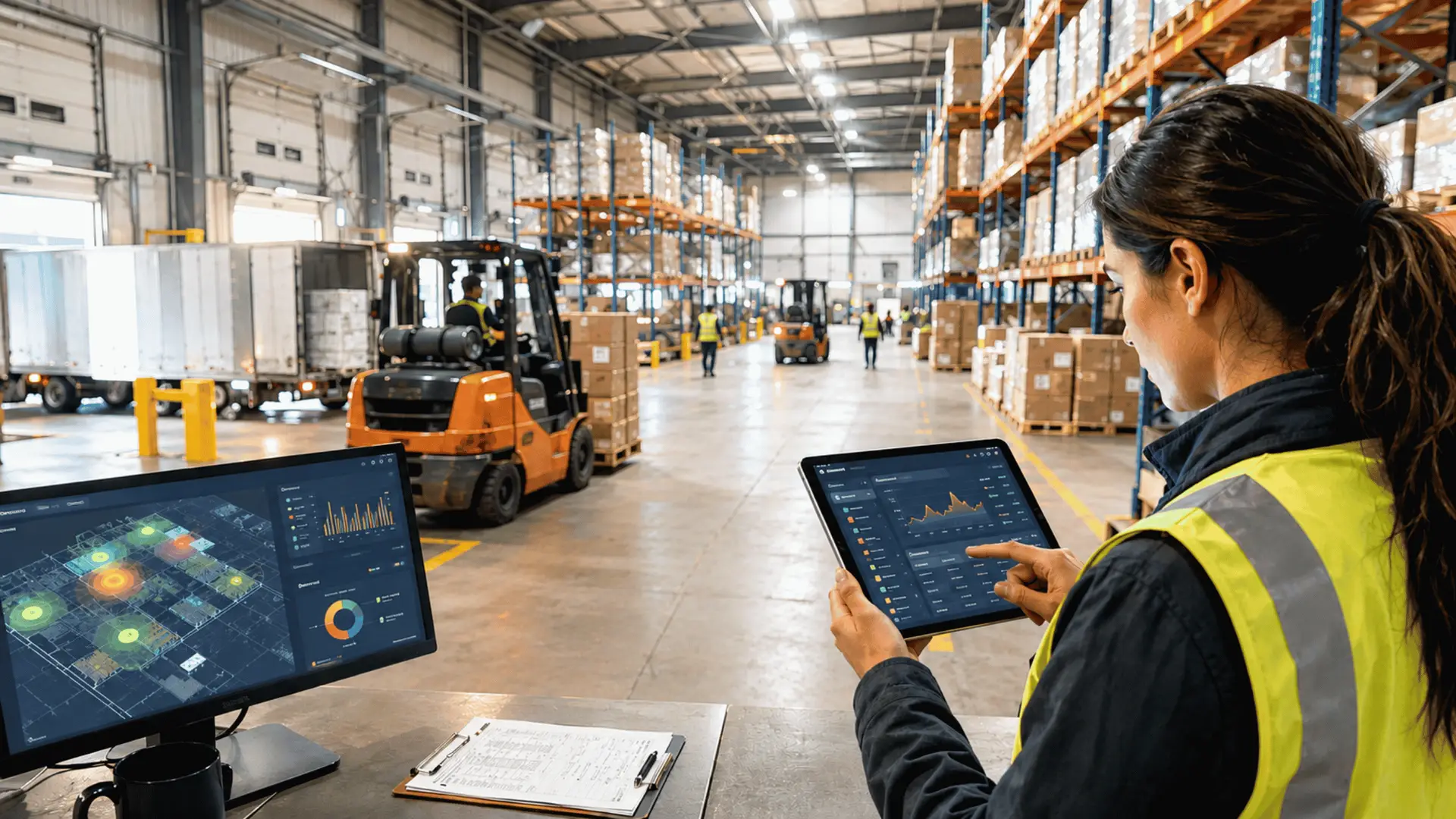
Authored by Sarvesh Uttarwar, Innovation & Emerging Technologies, Körber Stellium“Traditional reporting tells you what happened. Predictive analytics gives you time to change what happens next.”
Most supply chains are not short on data. They are short on time. By the time a weekly report shows a stockout, a missed service level, or a congested dock, the event has already happened and the cost is already booked. Predictive analytics in the supply chain exists to close that gap. Instead of describing what went wrong last week, it estimates what is likely to go wrong next week, while there is still room to do something about it.
That is the core shift worth paying attention to. Traditional reporting made supply chains better at explaining the past. Predictive analytics makes them better at acting on the future. The difference sounds subtle on a slide, but on a warehouse floor or in a planning meeting it changes what people spend their day doing.
Traditional Reporting vs Predictive Analytics: What Actually Changes
How Predictive Intelligence Improves Supply Chain Planning Accuracy
Predictive Analytics in Supply Chain Operations: What This Looks Like in Practice
Getting Started with Predictive Analytics
Traditional Reporting vs Predictive Analytics: What Actually Changes
It helps to be precise about the distinction, because both approaches use the same underlying data and often live in the same systems.
Traditional reporting is retrospective.
Dashboards, KPI scorecards, and month-end reviews answer the question of what happened. Inventory turns, fill rates, on-time delivery, and picking productivity are all measured after the fact. A good report is accurate, consistent, and comparable over time. What it cannot do is warn anyone. When a report flags a problem, the reaction is an investigation, and investigations take time the operation no longer has.
Predictive analytics is forward-looking.
It uses the same transactional history, but instead of aggregating it into a rear-view summary, it models patterns in demand, lead times, consumption, and movement to estimate what comes next. The output is not a chart of last month. It is a stock-out risk score for a specific SKU, a projected breach of a reorder point ten days out, or a congestion forecast for a receiving dock on Thursday afternoon.
The practical consequences of that difference show up in three places: how far ahead teams can see, what a signal triggers, and who the information serves.
- Time horizon. Reports look backward over a closed period. Predictions look forward over an actionable window, which is the only window where intervention is cheap.
- Trigger. A report triggers a review meeting. A prediction triggers a decision, such as expediting a purchase order, rebalancing stock between locations, or reassigning labor before a peak.
- Audience. Reports are built for management review. Predictive signals are built for the planner, the shift lead, and the inventory controller who act on them daily.
None of this makes reporting obsolete. Compliance, performance management, and continuous improvement still need a reliable record of what happened. The point is that reporting alone leaves an operation permanently one step behind its own supply chain. Predictive intelligence is what puts it a step ahead.
How Predictive Intelligence Improves Supply Chain Planning Accuracy
Planning is where predictive analytics usually earns its first results, because planning is where the cost of being wrong compounds quietly.
Most planning parameters in a typical operation are static. Safety stocks were set during implementation, reorder points reflect demand patterns from two years ago, and lead time assumptions come from supplier contracts rather than supplier behavior. The operation then drifts away from those assumptions one order at a time, and nobody notices until service levels dip or excess stock piles up in the annual count.
Predictive models attack this drift directly. By continuously analyzing actual consumption, actual replenishment behavior, and actual lead time variability, they can recommend safety stock and reorder point adjustments per SKU and per location instead of relying on blanket rules. They flag slow movers on their way to becoming dead stock while there is still time to redeploy or sell through them. They project demand at a granularity and refresh rate that a monthly planning cycle cannot match.
The result is not a perfect plan, because no model delivers that. The result is a plan that corrects itself faster than the business drifts, which is what planning accuracy actually means in practice. Planners stop maintaining parameters and start reviewing recommendations, and the difference in workload alone is often enough to justify the effort.
Predictive Intelligence for Proactive Exception Management
Exception management is the discipline most transformed by the move from reporting to prediction, because an exception is by definition something a report can only show you after it has occurred.
In a reporting-driven operation, exception handling is archaeology. An order failed, a shipment is late, a location is out of stock, and someone reconstructs the chain of events to find out why. The work is skilled and necessary, and it produces no value beyond preventing the same failure the same way next time.
A predictive setup inverts the sequence. The system monitors leading indicators such as rising demand variability on a SKU, a supplier whose lead times are stretching, inbound volume building toward a dock’s capacity, or picking rates falling behind the day’s wave plan. When the projected trajectory crosses a risk threshold, it raises the exception before the failure, along with the context needed to judge it.
This changes the economics of an exception. A stock-out flagged five days early is a transfer order. The same stock-out discovered in a report is a lost sale, an unhappy customer, and an expedited shipment at premium freight rates. The exception did not get cheaper because anyone worked harder. It got cheaper because the information arrived while the cheap options were still open.
It also changes what exception queues look like. Instead of a backlog of failures sorted by age, teams work a short list of emerging risks sorted by probability and impact. The judgment still belongs to people. What the model contributes is the early warning and the prioritization, which is exactly the part humans struggle to do across thousands of SKUs at once.
Better Operational Decisions : Identifying supply chain risks earlier
:Beyond planning cycles and exception queues, predictive analytics earns its keep in the small operational decisions that happen dozens of times a day and never make it into any report.
Where should today’s replenishment labor go first? Which inbound trailers should be prioritized at the dock? Which orders are at risk of missing their carrier cutoff? Which storage zone is heading toward congestion this afternoon? These decisions are individually minor and collectively decisive. Made well, they keep an operation smooth. Made on instinct alone, they produce the daily firefighting that experienced supervisors know too well.
Predictive signals give these decisions a factual footing without slowing them down. A congestion forecast turns dock scheduling from a negotiation into a plan. A projected picking shortfall moves labor two hours before the backlog forms instead of two hours after. A carrier cutoff risk score tells a shift lead which twenty orders out of two thousand deserve attention right now.
The principle carries over from every successful AI deployment in the supply chain: the system informs, and the person decides. A supervisor who knows a key customer, a fragile product, or a short-staffed team will overrule the model, and should. What the model removes is the guesswork about where to look.
Predictive Analytics in Supply Chain Operations: What This Looks Like in Practice
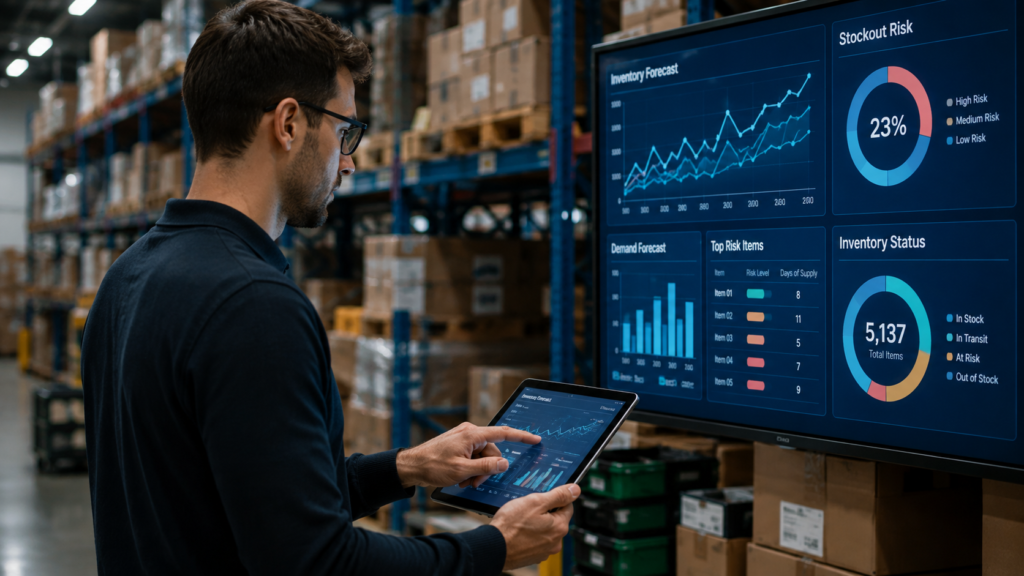
Inventory and stockout risk
Consider a consumer goods distributor running a high-volume regional warehouse. Its reporting was mature: daily KPI dashboards, weekly service reviews, monthly inventory analysis. Yet stock-outs on promoted items kept recurring, and every root cause analysis reached the same conclusion, which was that demand had shifted faster than the monthly planning cycle could react. After introducing predictive stock-out risk scoring across its catalog, the pattern changed. Planners began each morning with a ranked list of SKUs projected to breach safety stock within their replenishment lead time, and expedites became targeted transfers instead of panic orders. The reports still ran, but they started confirming decisions that had already been made rather than revealing problems that were already expensive.
Or take a healthcare logistics operation managing critical supplies across multiple facilities. Here the cost of a miss is not a lost sale but a clinical risk, so the operation historically compensated with heavy safety stock and the working capital that comes with it. Predictive consumption models allowed it to hold less while missing less, because the buffer moved from physical inventory to information. Items trending toward shortage were flagged and redistributed between facilities days ahead of need, and dead stock in low-consumption locations was identified while it could still be rotated rather than written off.
The industries differ, but the shape of the outcome repeats. The operations did not become smarter because they collected new data. They became faster because the data they already had started arriving as foresight instead of history.
Getting Started with Predictive Analytics
As with any analytics initiative, the failure mode is rarely the mathematics. A few practices consistently separate the deployments that stick from the pilots that fade:
- Start from decisions, not data. Pick two or three recurring decisions with clear cost, such as expedites, stock-outs, or dock congestion, and predict for those first.
- Use the transactional data you already trust. Order history, stock movements, and confirmations in your ERP or WMS are usually enough to begin. Perfect data is not a prerequisite.
- Put predictions where the work happens. A risk score inside the planner’s daily workflow beats a separate analytics portal nobody opens.
- Keep people in the loop. Show the drivers behind each prediction so teams can challenge it, and let their overrides improve the model.
- Measure avoided cost, not model accuracy. Fewer expedites and fewer stock-outs are the numbers the business will believe.
Advancing Reactive Reporting to Proactive Supply Chain DecisionsTraditional reporting is not going away, and it should not. But its role is changing from the primary lens on the supply chain to the audit trail behind it. The operations pulling ahead are the ones treating their data as a source of foresight, using predictive analytics in the supply chain to price risk before it materializes and to place people where judgment matters most.
Proactive beats reactive not because prediction is glamorous, but because acting early is cheaper than reacting late, every single time. The data to make that shift is already sitting in most ERP and warehouse systems today. The question is simply whether it keeps telling you what happened, or starts telling you what to do next.
Key Takeaways:
- Predictive analytics shifts supply chains from explaining the past to acting ahead of it.
- Planning accuracy, exception management, and daily decisions improve first.
- Reports describe problems. Predictions leave time to prevent them.
Turn supply chain data into foresight
For supply chain leaders evaluating predictive analytics, the practical next step is not a large transformation program. It is picking two or three recurring decisions with a clear cost, such as an expedite, a stockout, or a dock delay, and testing whether a focused prediction can catch the problem early enough to change the outcome. Teams that start this way build the track record, and the confidence, needed to scale into demand, inventory, and network-wide predictions across the organization.
To discuss how predictive analytics can be applied to your supply chain's specific planning, exception management, or operational decisions, reach out to the team to find the right place to start. Explore how Körber Stellium’s supply chain innovation combines AI, advanced analytics, and automation to help supply chains move from hindsight to faster, more proactive decisions.