

Authored by Subramanian G, Digital Supply Chain Practice, Körber Stellium“How SAP EWM turns warehouse data into real-time visibility, the pain points it solves, the KPIs it improves, and what successful implementation requires”
Ask ten warehouse managers whether they have visibility (be it inventory visibility, throughput, productivity or even handling exceptions), and ten will say yes.
Ask them what the current throughput of their pickers is or how many orders have shipped today, or how many are due for shipping, and the answers get much quieter, even in warehouses that are WMS driven.
While this gap is the single most expensive blind spot in warehouse operations, it is also one that SAP EWM was built to close.
This blog is a practitioner’s view of how EWM does that, drawn from our implementation experience across DCs, manufacturing plants, and automated facilities.
What real-time warehouse visibility means
Warehouse KPIs improved through real-time visibility
How SAP EWM closes the gap
Practical EWM implementation considerations for Visibility
Building sustainable real-time warehouse visibility
What real-time warehouse visibility means
Most organizations conflate two very different things: knowing their warehouse by experience and measuring their efficiency in real time.
Specifically, a well-maintained warehouse is expected to provide a 360-degree view of warehouse operations and health, measured in real time across multiple dimensions and against specific targets. At a minimum, it needs to answer the following questions immediately and intuitively:
- What are the orders that are due and what is their current status?
- How should the workload for the day or shift be managed?
- What is the throughput of various functions in the warehouse?
- Which exceptions have been handled today?
- What is the current status of inventory?
In general, ERPs are designed to provide inventory accounting and record data of sales/procurement, while a WMS is designed to provide operational insight, highlight inefficiencies and create opportunities for improvement. For this purpose, the data in the WMS must represent physical reality as accurately and as close to real time as possible. This is where inventory accuracy becomes essential, ensuring that system-recorded stock matches what is physically available across the warehouse.
Warehouse KPIs improved through real-time visibility
Visibility is not a benefit in itself. It is an enabler, and it should be measured through the operational metrics it changes. The table below reflects the areas where we consistently see movement following a well-executed EWM implementation, based on our experience.
Actual figures depend heavily on the maturity of the starting point.
| KPI | Visibility via EWM Enablement | Typical direction of movement |
| Inventory Record Accuracy | Bin-level stock, HU traceability and cycle counting by ABC class replace periodic wall-to-wall counts | Rises toward 99%+; adjustment volume and value fall |
| Dock-to-Stock Time | Receipt, deconsolidation, quality status and putaway are confirmed as they happen rather than batched | Falls; received stock becomes sellable materially sooner |
| Pick Accuracy / Order Accuracy | System-directed picking with scan verification at the point of pick | Mis-picks or Nil-picks fall sharply; returns and credit notes follow |
| On-Time In-Full (OTIF) | Reliable availability data and earlier exception detection protect the promise date | Improves; short-ships driven by phantom stock largely disappear |
| Order Cycle Time | Wave management, warehouse order creation rules and live queue monitoring smooth the flow of work | Falls, with a narrower spread between best and worst orders |
| Labor Productivity | Travel-optimized task sequencing and visibility of idle resources and queue build-up | Lines picked per hour rise; overtime dependency falls |
| Aged and Obsolete Stock | Stock age, batch and shelf-life visibility at bin level surfaces slow movers early | Write-offs fall; FEFO compliance improves |
| Inventory Carrying Cost | Confidence in accuracy allows safety stock buffers to be reduced deliberately | Falls, usually the largest single financial benefit |
| Cost per Order Line | The aggregate effect of the above on labor, rework and expedited freight | Falls; the metric CFOs tend to ask for first |
One caution worth stating: measure the baseline before go-live, honestly and with the same definitions you intend to use afterward. A great deal of post-implementation debate is really an argument about what the numbers were beforehand.
The pain points we see, almost without exception
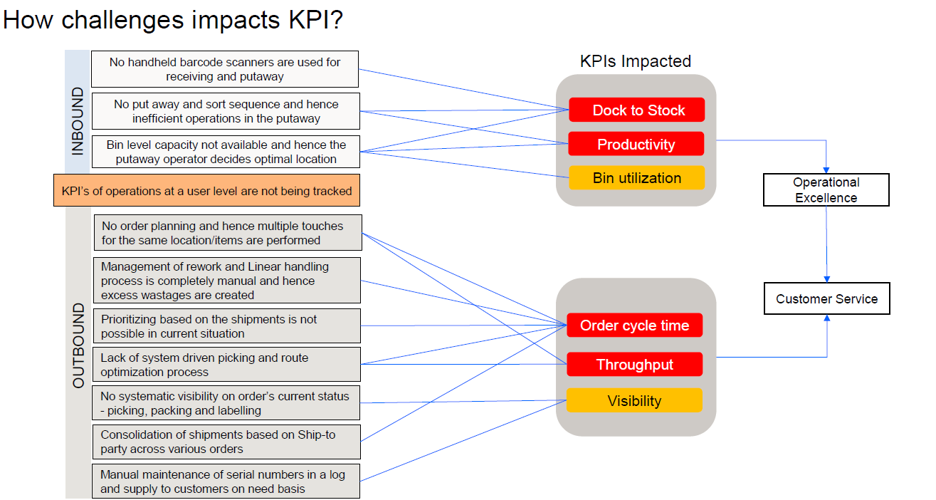
Across assessments, the same symptoms recur regardless of industry or region. They are worth naming plainly, because they are the business case.
| 📦 Phantom stock Stock is accurate in the system but not on the floor. | ⏱ Event latency Latency between the physical event and the system event. |
| 🤖 Automation islands Subsystems that run outside the warehouse system of record. | 🚨 Late exceptions Exceptions surface too late because there is no systematic way for an operator to handle them without needing a desktop/laptop. |
| 👷 Blind supervision Supervisors find it hard to monitor operations and even harder to take corrective actions, until it’s too late. | 📊 Backward-looking reporting Reporting that describes the past. |
How SAP EWM closes the gap
EWM does not deliver visibility as a reporting feature bolted on at the end. It delivers it as a by-product of how the system models work. Four design principles do the heavy lifting.
1. Granular Inventory Modeling
Stock is modeled at bin and handling unit (HU) level, with information on its nature (blocked, quality restricted), attributes such as COO, relevant dates (manufacturing/expiry) etc.
- EWM maintains its own inventory model beneath the ERP stock
- Every quantity carries a storage bin and an HU (HU management is used in most cases)
- HU identities can also nest — items in a carton, cartons on a pallet, pallets in a container
- Scanning one license plate resolves everything beneath it
Stock types (with availability groups) map that physical reality back to ERP’s financial view, so warehouse operations gain granularity without the books losing integrity
2. Live Operations through Mobile Device Integration
Every physical movement is confirmed at the point of work through mobile devices communicating with the EWM backend in real time
- EWM’s WT and WO model means work is not merely instructed — it is confirmed by the operator, on the floor, at the moment of execution. The system event and the physical event become the same event
- This is what removes latency, and it is also the discipline most often underestimated during implementation
This is achieved through EWM’s native ability to integrate with any mobile device, as long as it supports a browser (no add-ons, no additional investment, no setup time)
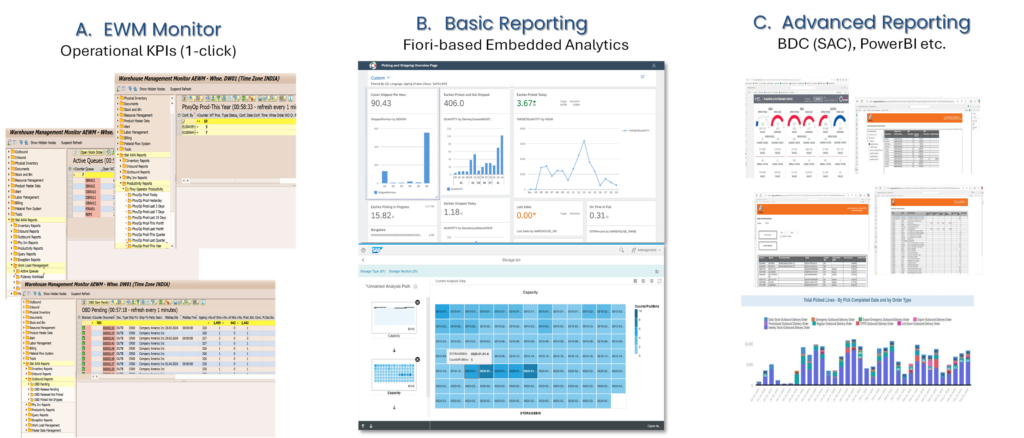
3. EWM Monitor as an In-built operational cockpit
This single app provides views of all warehouse operations coupled with the ability to transact
- EWM’s Monitor app acts as the single view any supervisor, manager or senior leader needs
- It presents one view in a hierarchical tree for the complete warehouse
- Open work with status, priority, zone-wise breakup, user status (location, queue etc.)
- Orders/Deliveries with statuses and expected completion times
- Workload management via waves, open work with queues, priority, expected completion times etc.
- Live inventory & Physical inventory documents
- Exception management such as Alerts, failed interfaces, exception codes
- Supervisors can also act directly from it — reassigning queues, users, releasing waves, and so on
Combined with our proprietary AWA™ Monitor add-on, EWM becomes both informative and interactive, a powerful cockpit for all things operational – supervisors intuitively work the warehouse from one app with all modern KPIs from Day 1.EWM Monitor and AWA™ Monitor Dashboards
4. Automation – Integrated, Not Interfaced:
EWM talks directly to automation subsystems
- EWM’s MFS directly communicates with PLCs and automation subsystems, tracking inventory and activities through automation devices as a first-class part of the warehouse model
- This principle also applies to robotics and third-party equipment: the equipment executes, but EWM remains the single system of record for operations
The result – A question like “show me every pallet of this batch, its bin, its status, its age and its commitment” becomes a query rather than an investigation.
See SAP EWM Monitor and AWA™ in Action
Practical EWM implementation considerations for Visibility
The functionality is well proven. What separates a warehouse that gets real visibility from one that gets an expensive stock report is a set of decisions made early, in design, and rarely revisited cheaply afterward.
1. Decide the granularity deliberately
Bin-level and handling unit management deliver precision, but each level of granularity has an operational cost in scans, labels and discipline. Decide granularity by material characteristics, storage systems and business value, not uniformly.
2. Adoption is the difference between design and outcome
RF discipline, scan compliance and confirmation at the point of work are behavioral. If operators can complete a shift while scanning selectively, visibility degrades quietly and the system takes the blame. Supervisor enablement on the Monitor matters as much as operator training on the handheld.
3. Instrument for analytics from day one
Decide early which measurement services and KPIs you will run, and make sure the underlying data — timestamps, resource assignment, exception coding — is being captured to support them. Retrofitting measurement after go-live means waiting a further quarter for a credible trend.
4. Design exception handling as part of the process
Any team can map a clean receipt. The value sits in what happens on a quantity discrepancy, a damaged handling unit, a failed automation handshake, a partial pick or a mid-shift priority change. Exception codes, alert routing and escalation paths should be designed with the operations team, not retrofitted during hypercare.
5. Interface design determines whether “real-time” survives contact with reality
Queue configuration, error handling, monitoring and reprocessing across the ERP and automation interfaces are what keep the picture live under load. An interface that is real-time on a good day and silently queued on a busy one produces a worse outcome than an honestly batched one, because people trust it when they should not.
Closing thought: Building sustainable real-time warehouse visibility
Real-time visibility is not a dashboard, and it is not simply knowing where stock sits. It is the ability to report on the whole operation, inventory, open work, throughput, productivity and exceptions — from data that is accurate at the moment it is read. Four design choices make that possible:
📦 Model stock where it physically exists — bin and handling-unit level, so the record mirrors the floor rather than approximating it.
📲 Confirm every movement where and when it happens — the system event and the physical event become the same event.
📊 Instrument for measurement from day one — timestamps, resource assignment and exception codes are what turn accurate data into reporting.
⚠️ Measure the baseline before you change anything — Accuracy, dock-to-stock, OTIF and cost per order line only prove a benefit if you know honestly where they started.
🎯 Get that right and the reporting builds itself, because every metric is drawn from a record that already matches the floor. Get it wrong and no amount of analytics will recover it: a report is only ever as current and as accurate as the event that fed it. That is precisely why the design phase, not the build phase, is where warehouse visibility is won or lost.
See it on your own warehouse visibility- not on a slide
We can activate our proprietary AWA™ Monitor and simulate your warehouse before a single object is built. A working session, not a slide deck.
A live walkthrough of the EWM Monitor and AWA™ running on your own process flows.
Agranularity and KPI review of the decisions that are cheap in design and expensive after go-live.
An honest baseline, so the numbers you quote after go-live actually mean something.
Bring Real-Time Visibility to Your Warehouse
Watch the demo video to see how EWM Monitor and AWA™ support live operational visibility, faster exception handling, and more confident warehouse decisions.
Explore our SAP EWM solutions to understand how Körber Stellium helps organizations improve warehouse control, performance, and scalability. Talk to our EWM experts