

Authored by Toshif Husen Patil, Innovation & Emerging Technologies, Körber StelliumFrom Joule Agents to autonomous supply chains: what SAP’s latest AI moves mean for warehouse, transport and production
SAP Business AI is transforming enterprise operations through embedded intelligence, Joule Agents and agentic workflows. Unveiled at SAP Sapphire 2026, SAP Business AI Platform (BAIP) combines SAP Business Technology Platform (BTP), SAP Business Data Cloud (BDC) and Business Transformation Management (BTM) capabilities. It enables enterprises to build, contextualize and govern AI agents grounded in business data and processes. Supply chain use cases include predictive labor planning in SAP EWM, conversational transportation planning in SAP TM and production disruption management in SAP Digital Manufacturing. Successful adoption requires trusted data, governed workflows, human oversight and measurable business outcomes to scale responsibly.
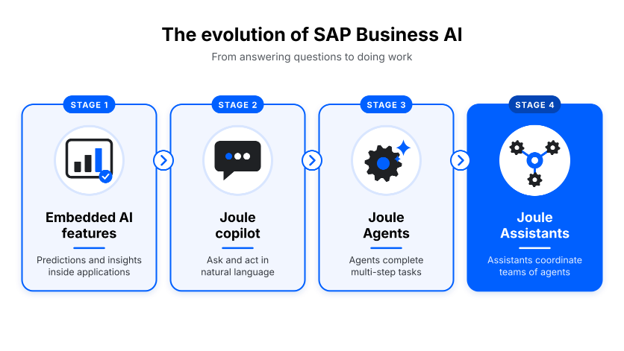
For most of the last decade, AI in enterprise software meant a chatbot or a forecast inside a report. In 2026 that has changed. SAP Business AI has moved from answering questions to doing work: agents that reconcile accounts, plan warehouse labor, re-plan freight, resequencing production orders and respond to supply disruptions inside the SAP processes companies already run.
For operations leaders, the question is no longer whether AI will reach the core of ERP. It is how fast it gets there, where it creates real value, and what has to be in place before it can be trusted with mission-critical processes.
From copilot to coworker: how SAP Business AI has evolved
SAP has moved quickly. By the end of 2025, SAP planned to have delivered 400 SAP Business AI use cases in its solutions, including 40 Joule Agents built on 2,100 Joule skills. At SAP TechEd in November 2025, SAP also launched SAP-RPT-1, its first relational foundation model, pre-trained to understand structured business data and predict business outcomes.
At SAP Sapphire in May 2026, SAP took the next step and introduced what it calls the Autonomous Enterprise. The new SAP Autonomous Suite adds more than 50 domain-specific Joule Assistants across finance, supply chain, procurement, HR and customer experience. These assistants direct more than 200 specialized agents that carry out precise tasks.
This matches where analysts see the market heading:
- Gartner predicts that up to 40% of enterprise applications will include integrated task-specific AI agents by 2026, up from less than 5% in 2025.
- Gartner also expects at least 15% of day-to-day work decisions to be made autonomously through agentic AI by 2028, up from 0% in 2024.
SAP Business AI architecture and capabilities : The foundation that makes the agents work
An agent is only as reliable as the business context it can see. That is why SAP’s 2026 announcements put as much weight on the platform as on the agents themselves.
- SAP Business AI Platform brings SAP Business Technology Platform, SAP Business Data Cloud and SAP Business AI together in one governed environment.
- SAP Knowledge Graph sits at its core. It gives agents a structured map of business entities, processes and relationships across a customer’s SAP landscape.
- SAP Business Data Cloud provides harmonized SAP and non-SAP data. SAP has added zero-copy data sharing with Snowflake, alongside existing integrations with Databricks and Google Cloud.
- Joule Studio is SAP’s environment for building agents, applications and agentic workflows, with no-code and pro-code options on SAP-managed infrastructure.
Openness is part of the design. SAP announced bidirectional agent-to-agent interoperability with Google Cloud and Microsoft agent frameworks, and sovereign model options from Mistral AI and Cohere. SAP also named Anthropic’s Claude among the foundation models that will power Joule agents across HR, procurement and supply chain.
Trust is the other half. SAP states that customer data stays within the customer’s SAP tenancy with tenant-level isolation, and that no customer data is stored within Joule.
How Joule Work and Joule Agents Transform Enterprise Workflows with SAP
The most visible change for users is Joule Work. Instead of moving between transactions and entering data screen by screen, users describe the outcome they want. Joule then coordinates the right workflows, data and agents to deliver it. It also surfaces insights proactively and runs routine tasks in the background. Joule Work is planned for desktop, mobile and voice, across SAP and non-SAP systems.
For teams used to SAP GUI transactions, Fiori apps and RF screens, this is a significant shift. The user sets the goal, and the system does more of the navigation.
The entry barrier is also lower than many expect. Customers with an existing SAP cloud subscription can activate Joule base at no extra charge, which makes it a practical first step for teams that want to test AI on their own processes.
SAP Business AI Use Cases Across Enterprise Operations
Finance
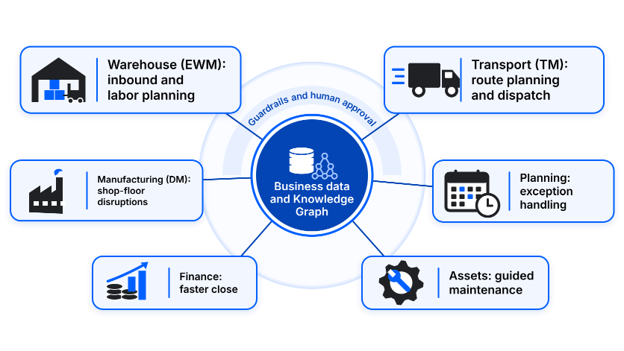
The Autonomous Close Assistant automates journal entries, reconciliation and error resolution. SAP says it can shorten the financial close from weeks to days.
Supply chain planning
With Autonomous Supply Chain Management, SAP introduced six Joule Assistants for planning, manufacturing, logistics, asset and service, business network and product design. They are supported by more than 60 purpose-built agents that sense events, analyze impact and act within defined guardrails. General availability is phased through 2026. At SAP Connect in October 2026, SAP added new agents to these assistants. In planning, they sense and simulate plan exceptions in one workspace and show planners what changed. SAP lists them for general availability in Q4 2026.
Warehouse management with SAP EWM
The Logistics Assistant keeps warehouse and transportation execution moving as conditions change. New Joule Agents support decisions such as validating inbound receipts and aligning labor with real workload, and SAP Extended Warehouse Management (SAP EWM) gains predictive labor planning. SAP has also announced an Outbound Task Orchestration Agent that detects and resolves picking and packing issues in real time, planned for general availability in Q2 2026. SAP cited a natural ingredients producer that used the Logistics Assistant to turn multistep troubleshooting into a one-click resolution, recovering about a third of the time it used to lose.
Transportation management with SAP TM
In the transportation cockpit of SAP S/4HANA Cloud Private Edition, Conversational Planning lets planners run planning operations in natural language, including chains of several instructions. SAP states a 50% improvement in transportation planners’ productivity in route planning and scheduling. At SAP Connect in October 2026, SAP said its new logistics agents will also optimize outbound warehousing, fulfillment and transportation dispatching. For smaller and satellite sites, SAP Logistics Management, generally available since February 2026, combines warehousing and transportation in one cloud solution with Joule built in and carrier collaboration through SAP Business Network.
Manufacturing execution with SAP Digital Manufacturing (SAP DM) The Shop Floor Supervisor Agent helps supervisors judge how severe a disruption is, then re sequences production orders and reallocates resources. SAP estimates a 50% gain in supervisor productivity for handling disruptions and a 2% reduction in unplanned downtime. The newer Production Excellence Agent and Production Master Data Readiness Agent monitor production, quality and machine signals. AI also shows how design changes affect bills of materials, routings, lead times and costs before they reach the shop floor. Machine learning-guided visual inspection in SAP Digital Manufacturing can automate quality inspection tasks on the line.
From an implementation view, all three depend on data that already sits in the execution systems. EWM agents need accurate inbound deliveries, packaging specifications and processing times. TM planning needs current freight agreements, carrier data and transportation zones. DM agents need correct routings, work centers and resource data. Good execution master data becomes a prerequisite for good AI.
Asset management. In Autonomous Asset Management, agents analyze data from thousands of past incidents, identify likely root causes and create pre-filled work orders with proven fixes from other sites. SAP named RWE as a customer using this to reduce unplanned downtime on offshore wind turbines.
The reality check: why many AI agent projects stall
The ambition is real, and so is the risk. Gartner predicts that over 40% of agentic AI projects will be canceled by the end of 2027 because of rising costs, unclear business value or weak risk controls. Gartner also warns of “agent washing”, where existing assistants, RPA and chatbots are relabeled as agents.
The expected value is high. In SAP-commissioned research by Oxford Economics among 1,600 executives, organizations reported an average 16% return on AI investments and expect it to nearly double within two years. 78% believe AI agents could transform their business operations.
Two lessons follow from these numbers. First, value comes from agents embedded in real processes, not from standalone experiments. Second, an agent inherits every weakness of the process and data behind it. An unclear approval rule or an inaccurate stock figure becomes a wrong action, made faster. The gap between expectation and production results is where implementation discipline matters most.
Five steps to prepare your landscape for SAP Business AI
- Start with one process, not a model. Pick a high-volume, rule-heavy process with clear KPIs, such as inbound receipt validation in SAP EWM, route planning in SAP TM, shop-floor disruption handling in SAP DM or the period-end close.
- Fix the data foundation first. Agents grounded in SAP Knowledge Graph and SAP Business Data Cloud still need correct master data. Clean up product, packaging and storage bin data in EWM, freight agreements and carrier data in TM, and routings and work centers in DM before go-live.
- Know your entitlement path. RISE with SAP now includes Joule Assistants, with three activated in the first year. SAP GROW customers get the full portfolio at onboarding. SAP S/4HANA on-premise and SAP ECC customers who commit to move most of their landscape to SAP Cloud ERP get access to select AI scenarios.
- Define guardrails and human checkpoints. Decide which actions an agent can complete on its own and which need approval. Document it like any other authorization concept.
- Measure, then scale. Baseline KPIs before activation, compare after go-live, and extend to adjacent processes only when the value is proven.
A structured assessment of processes, data quality and system readiness is often the fastest way to find where these steps should start.
The Future of SAP Business AI and Autonomous Enterprises
SAP Business AI is turning ERP from a system that records work into a system that helps do it. The building blocks are now in place: a unified platform, a knowledge graph that gives agents business context, a growing set of Joule Assistants and agents, and a new way for people to interact with SAP.
The winners will not be the companies that switch on the most agents. They will be the ones that connect AI to clean data, well-designed processes and clear guardrails, starting where the business value is easiest to prove.
Accelerate Your SAP Business AI Journey
Körber-Stellium helps SAP customers move from AI pilots to productive use across warehouse, transportation, manufacturing and finance processes.
Explore our SAP Business AI services or talk to our SAP Business AI team to find the right starting point for your landscape