

Authored By Vishnu Raj Varma, Supply Chain Planning & Business Consulting at Körber Stellium Inventory has traditionally been managed through a simple trade-off: hold more stock to protect service levels or reduce inventory to improve working capital. In practice, neither approach works well when inventory decisions are based on static assumptions.
Inventory has traditionally been managed through a simple trade-off: hold more stock to protect service levels or reduce inventory to improve working capital. In practice, neither approach works well when inventory decisions are based on static assumptions.
Businesses today face an unusual situation: inventory levels are high, yet availability issues remain. The problem is not always the quantity of inventory. It is often a mismatch between where inventory is held, how much protection is required, and what customers actually value. A well-designed inventory strategy does not aim for maximum availability at any cost. It determines where inventory creates value and where additional stock only increases capital exposure.
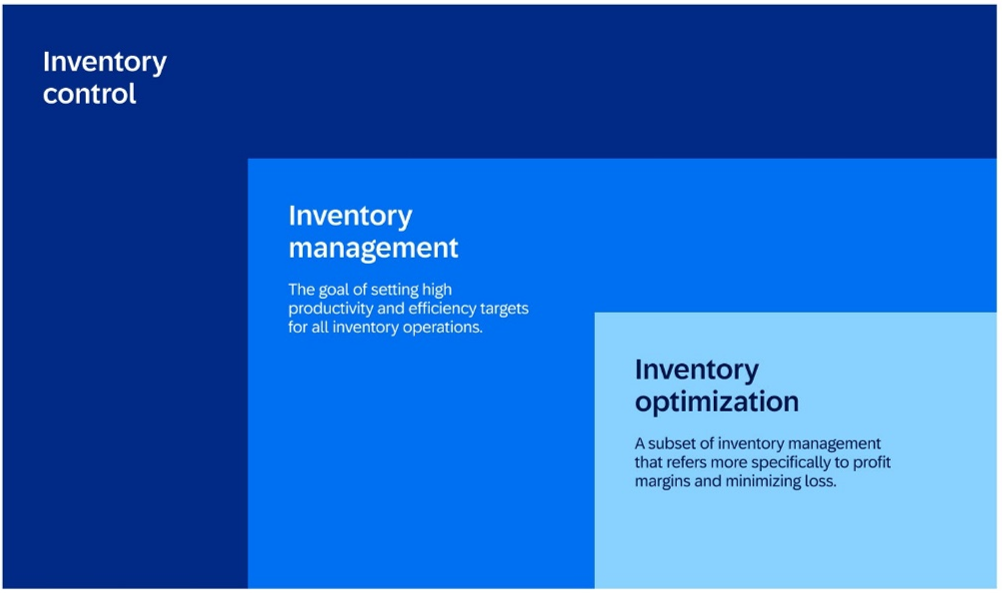
This requires moving from inventory management based on historical averages to inventory optimization based on demand variability, supply risk, and business priorities.
Why Does Traditional Inventory Planning Struggle with Uncertainty?
Safety stock remains one of the most widely used mechanisms to protect against uncertainty. The underlying concept is straightforward: maintaining additional inventory to absorb fluctuations in demand and supply.
A simplified safety stock calculation is: Safety Stock= Z×σ×√(LT), Where: Z represents the target service level,σ represents demand variability,LT represents replenishment lead time.The formula highlights an important point: inventory requirements are driven by uncertainty, not just demand volume.
However, many businesses struggle because these variables are not continuously updated. Safety stock parameters calculated during one specific condition often remain unchanged even when demand patterns, supplier performance, or lead times have shifted.
The result is predictable:
- Some products carry unnecessary inventory because demand risk has reduced.
- Other products experience shortages because inventory policies no longer reflect current uncertainty.
The objective is not to remove safety stock. It is to make safety stock more intelligent.
How Do Service Levels Affect Inventory Investment?
One of the biggest challenges in inventory optimization is understanding that service levels and inventory investment do not increase proportionally.
Improving availability from 90% to 95% may require a reasonable inventory increase. However, moving from 98% to 99.5% requires significantly more protection because the organization is preparing for increasingly unlikely demand events.
This is where inventory segmentation becomes critical.
A high-value industrial spare part, a consumer electronics product, and a seasonal retail item should not have the same inventory strategy. The cost of a shortage, the impact on customers, and the risk of excess inventory are different for each.
Strategy-driven organizations therefore differentiate inventory policies based on factors such as:
- Product criticality
- Customer impact
- Demand variability
- Supply reliability
- Business value
The objective is not to achieve the highest service level for every product. It is to achieve the right service level for each product.
Why inventory optimization must consider the entire network
Another limitation of traditional inventory planning is that it often treats each location as an independent decision point.
A manufacturing plant maintains stock to protect production. A distribution center maintains stock to protect customers. Regional warehouses create additional buffers to improve local availability.
While each decision may appear reasonable, the combined network may hold more inventory than necessary.
Multi-echelon inventory optimization (MEIO) addresses this challenge by considering inventory across the entire supply network. This approach uses the principle of risk pooling. Demand variability across multiple locations can often be managed more efficiently at a network level than through independent buffers at every node.
For example, a global manufacturer with multiple regional warehouses may discover that maintaining identical safety stocks across locations creates unnecessary inventory. A more balanced approach may involve positioning inventory at upstream locations while maintaining customer service commitments downstream.
SAP IBP Enabling better inventory decisions
Inventory optimization requires more than calculation. Planning-intensive businesses need the ability to continuously evaluate trade-offs between demand, supply, service requirements, and working capital. This is where integrated planning capabilities become important.
SAP Integrated Business Planning (SAP IBP) supports inventory optimization by connecting inventory decisions with broader supply chain planning processes. Instead of managing inventory targets separately, organizations can evaluate inventory requirements alongside demand forecasts, supply constraints, and service objectives.
Key capabilities include:
Inventory optimization and target setting
Organizations can evaluate appropriate inventory levels based on demand variability, service requirements, and supply characteristics rather than relying only on historical inventory rules.
Multi-echelon inventory optimization
SAP IBP supports analysis across different supply chain levels, helping organizations determine where inventory should be positioned across plants, distribution centers, and warehouses.
Scenario simulation
Supply chains rarely operate under fixed conditions. A supplier delay, demand increase, or capacity constraint can quickly change inventory requirements.
Scenario analysis allows planners to evaluate questions such as:
- How will a longer lead time affect safety stock?
- What inventory impact will increased demand volatility create?
- Where should inventory be positioned to protect customer service?
The value is not simply faster planning. It is better decision-making based on a more complete view of the supply chain.
Multi-Echelon Inventory Optimization Looks Like in Practice
Consider a consumer products company managing thousands of SKUs across multiple manufacturing plants, regional distribution centers, and retail markets.
The company faces a common inventory challenge: some locations carry excess stock while others struggle to maintain availability. Although total inventory across the network appears sufficient, products are not always positioned where demand occurs.
The underlying issue is the way inventory decisions are made. Each location has historically managed its own safety stock based on local demand patterns and service requirements. While this protects individual locations, it can result in duplicated inventory buffers across the network.
A multi-echelon inventory optimization approach changes this perspective. Instead of determining inventory requirements separately at each location, the organization evaluates the network as a connected system. Demand variability, replenishment lead times, supply constraints, and service-level targets are considered together to determine where inventory should be positioned and how much protection is required.
For instance, if one regional warehouse experiences highly variable demand while another has more predictable demand, maintaining identical safety stock policies may not be the most effective approach. A network-level model can identify whether inventory should be held closer to customers or positioned upstream where it can serve multiple markets more efficiently.
SAP Integrated Business Planning (SAP IBP) Inventory Optimization can support this type of decision-making by enabling planners to model inventory targets, evaluate service-level trade-offs, and simulate the impact of changing demand or supply conditions.
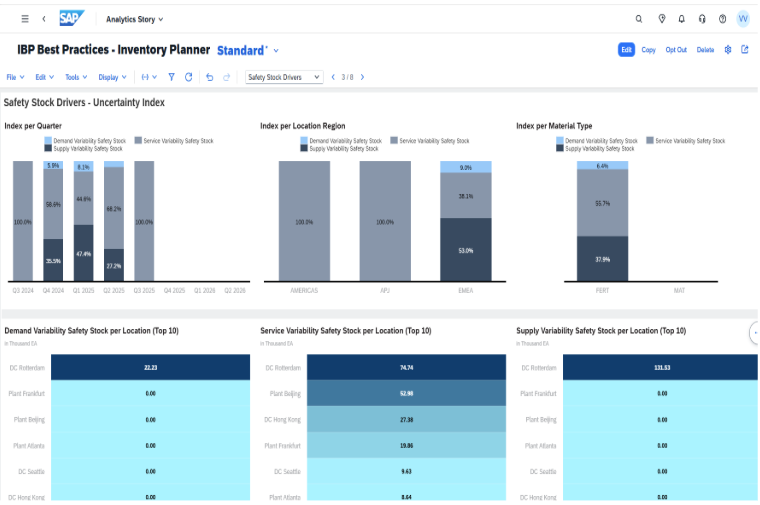
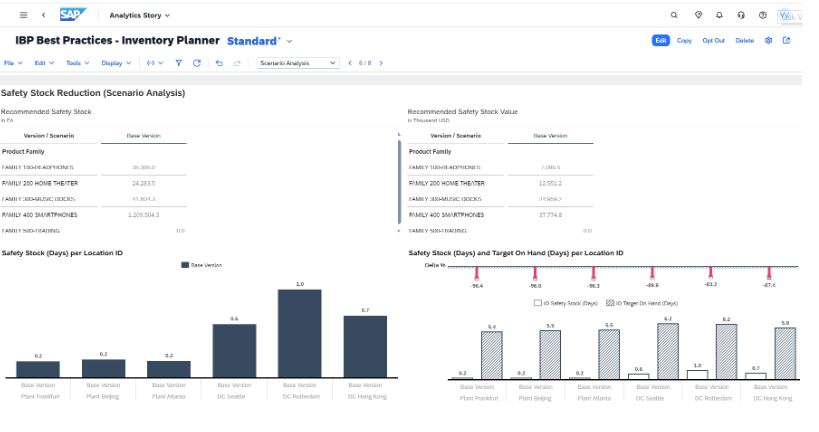
The objective is not to reduce inventory at every location. It is to ensure that inventory is placed where it provides the greatest business value while maintaining the service levels customers require.
How Can Businesses Build a More Resilient Inventory Strategy?
Inventory optimization is ultimately about managing uncertainty more intelligently.
Front‑runner enterprises that achieve better outcomes typically move away from static inventory rules and adopt a more dynamic approach:
- Inventory policies reflect current demand and supply conditions.
- Service levels are aligned with business impact.
- Inventory is optimized across the network rather than by individual locations.
Technology can support this transition, but the foundation remains a disciplined approach to decision-making.
The goal is not to eliminate inventory buffers. Buffers exist because uncertainty exists.
The goal is to ensure every unit of inventory has a purpose; protecting customer service, reducing operational risk, or supporting business priorities.
That is the difference between holding inventory and optimizing inventory.
Optimize Inventory Without Compromising Service Levels
SAP IBP helps organizations balance inventory investment, service levels, and supply chain risk through more connected, data-driven planning.
Körber Stellium can help you strengthen inventory planning and build a more resilient SAP IBP strategy. Talk to Our SAP IBP Experts